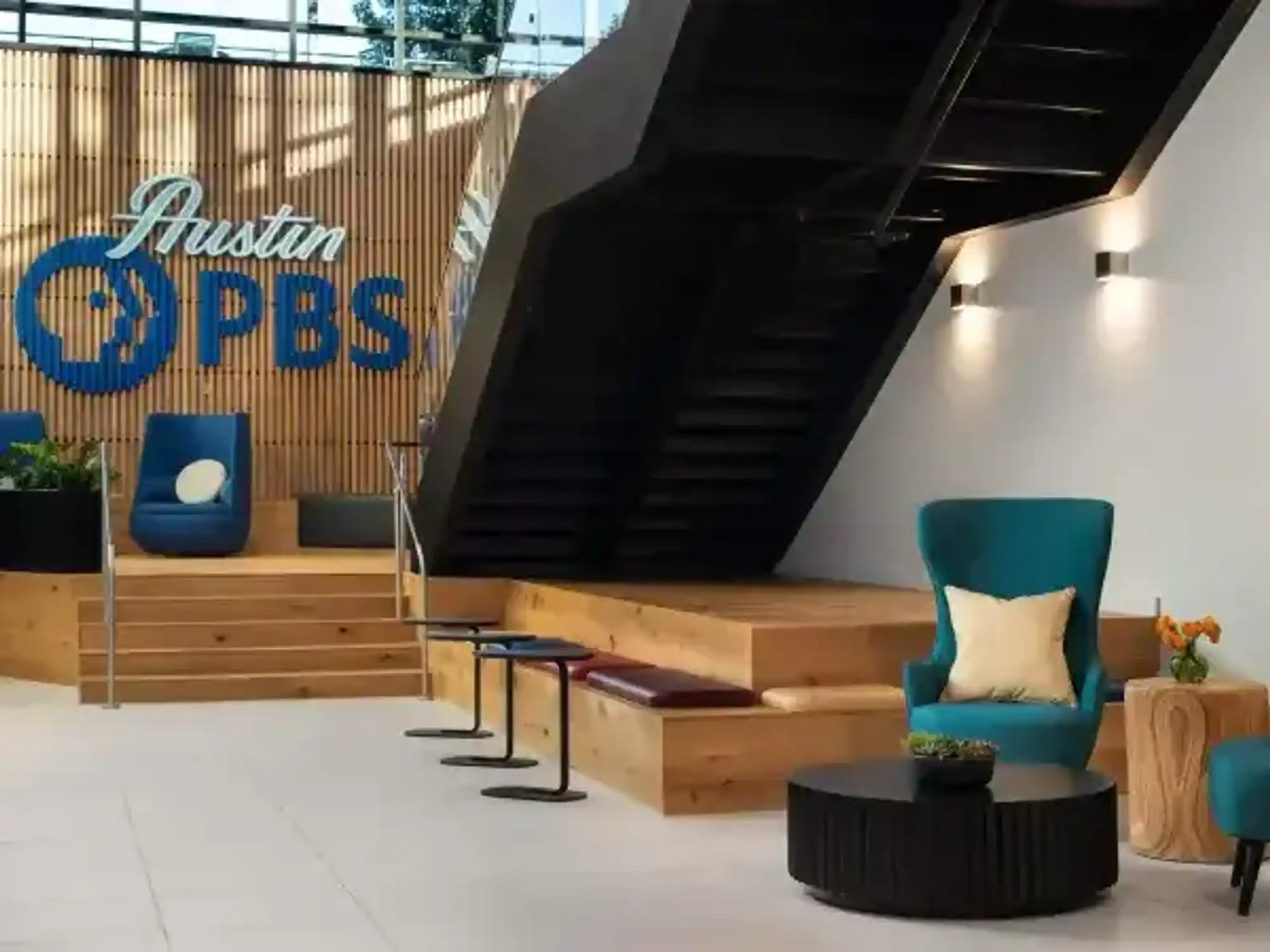
The South by Southwest (SXSW) Conference — the business side of Austin's famous festival — organizes its content into official "tracks" by topic, but there are also some unofficial patterns each year. In 2026, attendees interested in resilient public media and storytelling in the face of censorship and funding losses have had plenty to explore.
Of those unofficially related panels, CultureMap has attended three: one on the future of PBS, one on supporting public media in general, and one on telling fictional stories that are both diverse and appealing to wide audiences.
The story with PBS
"Trusted, Valued, Essential: Why PBS is Here to Stay, With or Without Federal Funding" was held on Monday, March 16, at the JW Marriott Austin. Managing director of the events at The Atlantic Evan Smith, who co-founded the Texas Tribune, interviewed PBS CEO Paula Kerger in a one-on-one conversation that discussed core goals at PBS and the policies it needs to react to in order to stay afloat.
In July of 2025, the Corporation for Public Broadcasting shut down as a result of a recissions package signed by President Donald Trump. That meant that PBS and NPR lost all federal funding. However, this only represents a portion of total funding, and that portion tends to be more substantial outside of big cities.
In the March talk, Kerger said the first sign that the Trump administration was "focused on" PBS was when the Federal Communications Commission (FCC) launched an investigation into how the two public media companies were handling underwriting. The FCC accused them of "airing commercials," but Kerger maintains that PBS was following "very clear guidelines" to acknowledge corporate sponsorship in running underwriting spots.
Smith and Kerger took care to separate PBS and NPR, noting that NPR is focused on news, while only about 10 percent of PBS content is news. PBS creates educational programs for everyone, but Kerger especially emphasized how much PBS caters to rural viewers and young children. She pointed out that PBS aims to fill gaps left by other media organizations, and that its science programming is one of its most important assets.
The conversation also returned a few times to Arkansas, where the state's public television commission voted March 12 to pause in disaffiliating with PBS. This is an important case because Arkansas is the only state whose public station started moving to disaffiliate from PBS after federal funding was lost. Kerger said her goal in meeting with the commission was to encourage its members to consult with the public before making a decision.
Kerger commended former Arkansas first ladies Gay White and Barbara Pryor — a Democrat and a Republican — for joining together to create Friends of Arkansas PBS to advocate for keeping PBS on the air.
Looking at what could happen if the Arkansas commission does decide to break with PBS, Kerger acknowledged that the organization does already have online-only content, and it could shift to a completely online model if removed from broadcasting. However, she pointed out that Arkansas has one of the lowest broadband penetrations in the country.
Kerger brought her points home when Smith put forth a common argument: Couldn't wealthy people step in and solve the funding problem with private donations?
"Now, what I'm suggesting is this: that the idea that our answer is simple, and that there is a single person that is going to solve it, is not a great idea," said Kerger. "What has made us strong is we are a system of the people — lots of small contributions and some slightly larger contributions ... I do think there is something about being part of this, everyone doing just that little bit that makes a big difference. So I do think that there is a huge argument to trying to be self-sufficient."
How to advocate for public media and the arts
Self-sufficiency was the theme of "Culture Under Fire: Storytelling for Public Power," a panel on March 12 featuring Lisa Varga of the American Library Association, Maya Chupkov of California Common Cause, Erin Harkey of Americans for the Arts, and Jax Deluca of the Future Film Coalition.
Harkey said that for the first time in her life, she is "seeing the strands of a real movement for culture and arts in this country starting to come together." She continued, "we may disagree on the small policy details, but we all believe in one sort of fundamental thing, which is that creative expression is incredibly important, if not central to democracy in this country."
She also pointed out research from the National Endowment for the Arts (NEA) in 2021 that found that NEA funding reached 773 counties that private foundation funds did not — a quarter of the country. As in the PBS discussion, this brings the conversation back to rural communities that don't have much, if any support from independent donors.
The panelists offered up concrete ways for people to get involved with protecting public media and arts organizations that have lost federal funding:
How to tell diverse stories that speak to anyone
On March 13 another panel, "Backlash Culture: Having the courage to tell the Full Story," focused on fiction and injected encouraging nuance into the hot topics of diversity, equity, and inclusion. Moderator Zaki Barzinji of the Doris Duke Foundation led panelists Dennis St. Rose of CAA Community & Impact, Vicki Shabo of New America, and Alex Schmider of GLAAD in a conversation about telling authentic stories that executives may see as too niche, but audiences have proved they love.
A fitting touchstone that St. Rose brought up is the underdog 2025 hit KPop Demon Hunters, which won two Academy Awards on March 15 for best original song and best animated feature. "I'm not gonna name names, but there were people that passed on that before it got to where it was," he said. Korean culture permeates every aspect of the film from the music, to the visuals, and even to the lore that informs the plot. But the universal human elements also shine through.
"I think there's the constant narrative that all of us are fed that, 'oh, that successful story is an exception,'" said Schmider. "Sinners is an exception, that's not the rule. KPop Demon Hunters, Heated Rivalry. Exception, not the rule. Well, at a certain point we have to question, but is it the rule?"
Specificity was an important theme across the entire discussion, with a prevailing belief that the more specific elements a story has — for example, discussions about childcare — the more authentic it feels. And this, the panelists agreed, was what audiences gravitate to even when executives worry about alienation.
"[There is] this misconception that specificity is the enemy of wide audiences, right?" recapped Barzinji. "People crave specificity in the stories and narratives that they watch; they don't have to immediately resonate with every person they see on the screen. In many ways, the specificity of a story breaks through all of the sameness that is currently saturating the market."
St. Rose wrapped up the session by previewing the Full Story Initiative Digital Toolkit, a database by CAA designed to help storytellers responsibly reflect different cultures and issues, with recommended partner organizations, case studies, market research, and more. The tool will launch April 28.