There is an entire Internet subculture devoted to predicting the Oscars. It has its own Vegas odds-makers, like sporting events, and several different blogs devoted to handicapping the ceremony. Hard and fast rules don't work, and even renowned statistician Nate Silver wasn't as good at predicting who got little gold men as he was at predicting how the 2012 election would unfold.
No matter. If you followed my advice last year, you went with a consensus arrived at after several years of obsessive following of pre-Oscar indicators, gut instinct, and a resolution to not take it so seriously. You also got 18 out of 24 categories correct, which is more than enough to win the pool at most offices or Oscar party pools.
This year should be no different if you follow my foolproof guide to the Oscars. These are the winners wrought by the awards season narrative, and I'll be absolutely sure of each one — until a few of them are wrong on Sunday.
Argo has made a late season push to the front of the pack for Best Picture. Hollywood loves itself, so a movie about making movies (sort of) could swoop in and prevent the solid, but straightforward Lincoln from Mitt-Romney-ing its way to victory.
Argo should pick up Editing and Adapted Screenplay awards as well, while Lincoln consoles itself with wins for Daniel Day-Lewis and Tommy Lee Jones performances, and Steven Spielberg's direction. In the other major categories, Jennifer Lawrence wins Best Actress by a nose for Silver Linings Playbook, while Anne Hathaway wins Best Supporting Actress in a landslide (pretty much just for singing the Susan Boyle song from Les Mis, which will also win Sound Mixing for its innovative live-singing production). In a wide-open race, Django Unchained stands poised to take Original Screenplay.
Life of Pi should take a bunch of technical awards for looking pretty — mark it down in cinematography, art direction, visual effects and throw in Best Score as a bonus. Skyfall will become only the third Bond movie to win an Oscar, taking home both Sound Effects Editing and Best Original Song for Adele's titular ballad. Anna Karennina easily wins Best Costumes, and The Hobbit wins makeup for dusting off the hobbit-feet.
That leaves Wreck-It Ralph winning Best Animated Feature, Amour (a Best Picture nominee) easily winning Best Foreign Language Film, Searching For Sugar Man taking Best Documentary, and finally the unpredictable short films. Getting one short film right is a good day: at least Paperman (a partially hand-drawn industry favorite) is a lock for Animated Short. I have gone with Curfew in Live Action Short (it has a cute little kid), and Mondays at Racine (it's about cancer) in Documentary Short.
Without further ado, here's my comprehensive guide to the Academy Awards. Best of luck! And if I'm way off, I promise all of your money back.
Picture: Argo Director: Steven Spielberg, Lincoln Actor: Daniel Day-Lewis, Lincoln Actress: Jennifer Lawrence, Silver Linings Playbook Supporting Actor: Tommy Lee Jones, Lincoln Supporting Actress: Anne Hathaway, Les Miserables Original Screenplay: Django Unchained Adapted Screenplay:Argo Editing:Argo Cinematography:Life of Pi Score:Life of Pi Song: "Skyfall" by Adele from Skyfall Art Direction:Life of Pi Costumes:Anna Karennina Sound Mixing:Les Miserables Sound Effects Editing:Skyfall Makeup: The Hobbit Visual Effects: Life of Pi Foreign:Amour Animated Feature:Wreck-It Ralph Doc Feature:Searching for Sugar Man Doc Short:Mondays at Racine Animated Short: Paperman Live Short: Curfew
Anne Hathaway, Les Miserables, for Best Supporting Actress.
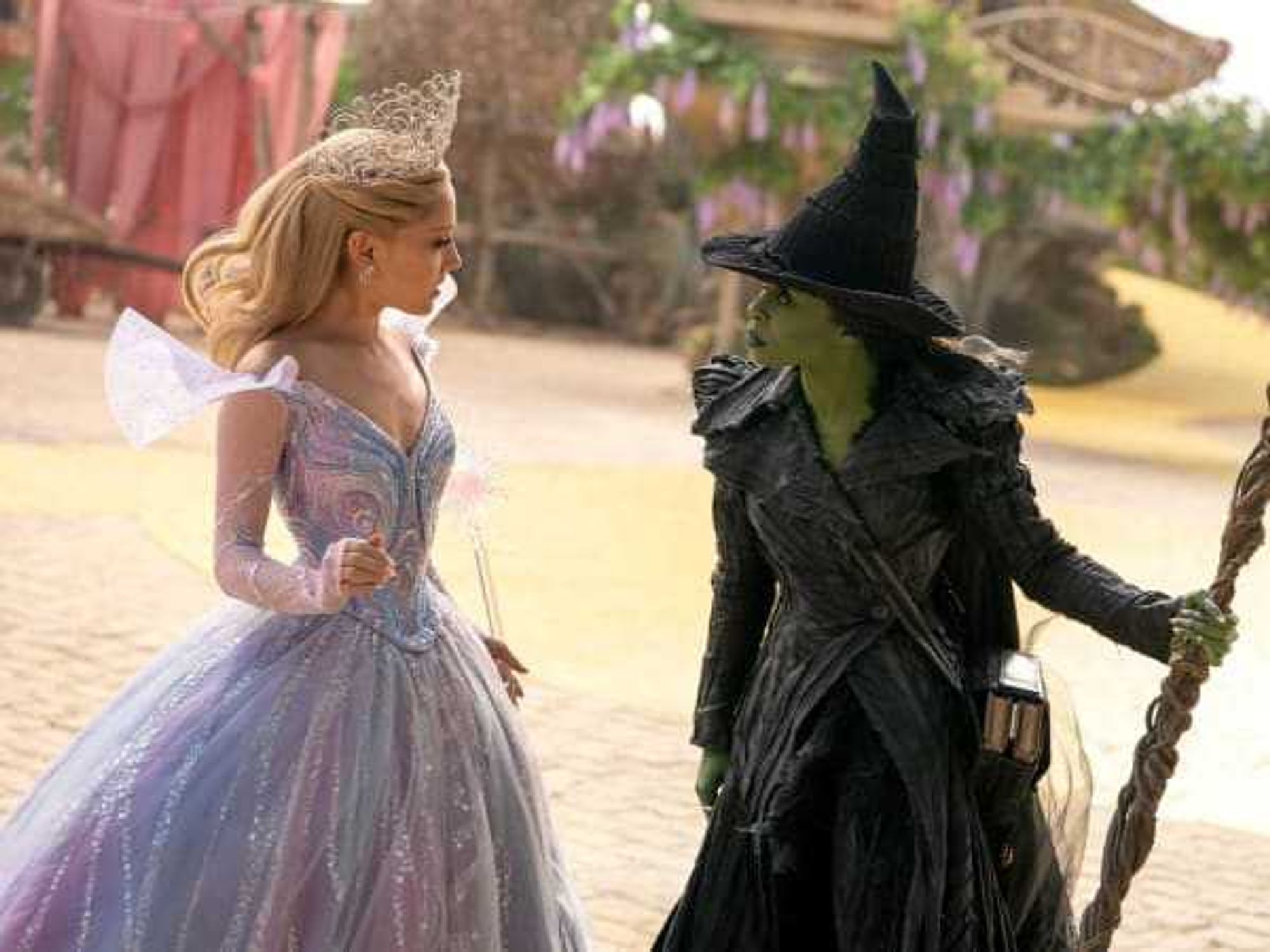
Ariana Grande and Cynthia Erivo in Wicked: For Good.
Splitting the film adaptation of the musical Wicked into two parts makes a certain kind of sense beyond the financial incentive of making fans pay for two films. Like most stage musicals, there’s a definitive break between the two acts, and it’s hard to resist going out on the high note of “Defying Gravity” for the first film. And expanding the story for the films puts the entire story at around 5 hours, much too long for one sitting.
However, separating them puts a spotlight on the strengths and weaknesses of each act of the musical, and it's a popular opinion that the second act is inferior to the first act. In the awkwardly-named Wicked: For Good, Elphaba (Cynthia Erivo) is firmly ensconced as the Wicked Witch of the West, striking fear in people across Oz. Meanwhile, Glinda (Ariana Grande) has ascended as the protector of the land’s citizens, even as she hides the fact that she doesn’t possess the powers that Elphaba does.
The story speeds through a number of different arcs, including Elphaba’s sister, Nessarose (Marissa Bode), becoming governor of Munchkinland; Glinda essentially forcing Fiyero (Jonathan Bailey) to commit to marrying her; even more bad revelations involving the Wizard of Oz (Jeff Goldblum) and Madame Morrible (Michelle Yeoh); and more. Hanging over all of it is the tenuous bond between Elphaba and Glinda, which is tested on multiple occasions.
Director John M. Chu, working from a script by original musical writer Winnie Holzman and Dana Fox, leads the way on the faithful adaptation that is perhaps a bit too faithful. Chu helmed the memorable adaptation of Lin-Manuel Miranda’s In the Heights that brought more life to an already lively production. He accomplished similar results in Wicked part one, but For Good often feels less than cinematic, with many scenes coming off as static and too much like a stage production.
The second film contains a lot of story movement, including the vague or explicit introduction of the four main characters from The Wizard of Oz, providing plenty of opportunity for creative staging or deeper storytelling. Instead, things just sort of happen, with Holzman and Fox failing to see the necessity of connecting story dots in a movie setting. With lots of extra time to work with (the run time is 2 hours and 17 minutes), giving more information about significant events shouldn’t have been an issue, and yet the filmmakers rarely give the audience that luxury.
The songs, as they should be, are the showcase of the film, and yet none of the sequences measure up to the ones in the first film. The rushed storylines make it difficult to connect with emotionally-resonant songs like “As Long As You’re Mine” and “No Good Deed.” “No Place Like Home” and “The Girl in the Bubble,” new songs created for the film for Elphaba and Glinda, respectively, are decent but lack power. “For Good” is the one everyone is waiting for, but it too fails to land properly.
Erivo and Grande certainly give it their all, and when they’re allowed to dig deep into their characters, they make as much of an impact as they did in the first film. Unfortunately, it’s nowhere near as often, and their characters’ bond suffers. Most of the other actors are done no favors by the whirlwind storytelling, but Goldblum still stands out in his various scenes.
Creating a whole film for the second act of Wicked gave Chu and his team a perfect chance to slow things down and give the events it contains extra meaning. Unfortunately, they turned For Good into something that feels less like an expansive movie and more like a slightly more interesting version of the stage production.
---
Wicked: For Good opens in theaters on November 21.