NEW YORK — Warning: The first words you’ll hear Carrie Underwood sing in NBC’s live production of The Sound of Music tonight might not be familiar. Which may be a good thing, because there’s a horde of cranky beasts out there who’ve been flooding the Internet with nasty remarks ever since the casting was announced.
Yes, we know — Underwood may be an American Idol darling, but she’s no Julie Andrews. Got it, thanks for the tip. Now, at least, the ad hoc critics will have to sit quietly and listen — for a few seconds anyway — before they start tweeting again.
"I’ve always been up for a challenge,” says Underwood, who’s never performed in a musical. Not even in high school, back in Checotah, Oklahoma.
If you’re a fan of The Sound of Music — the stage show (which first hit Broadway in 1959 starring Mary Martin) — as opposed to the beloved 1965 film version (starring a legendary you-know-who), the opening lyrics sung in the NBC version will come as no surprise. They were cut from the film, where the opening bars are instrumental — likely because the lyrics mention it’s evening, and 20th Century Fox had paid for all that glorious footage of the Alps … in daylight.
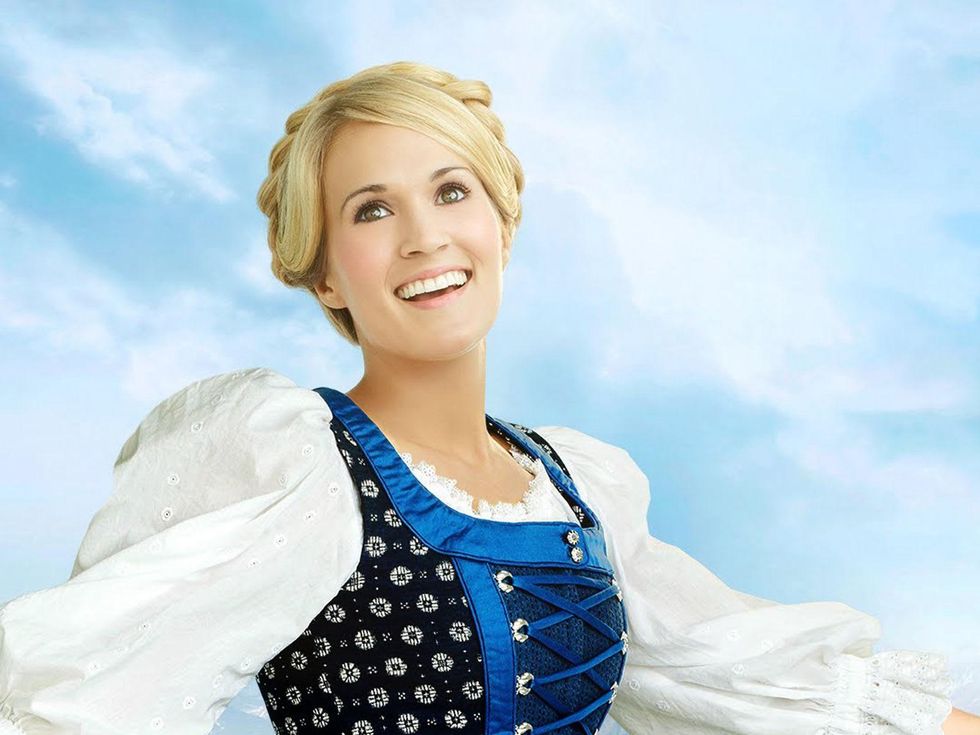
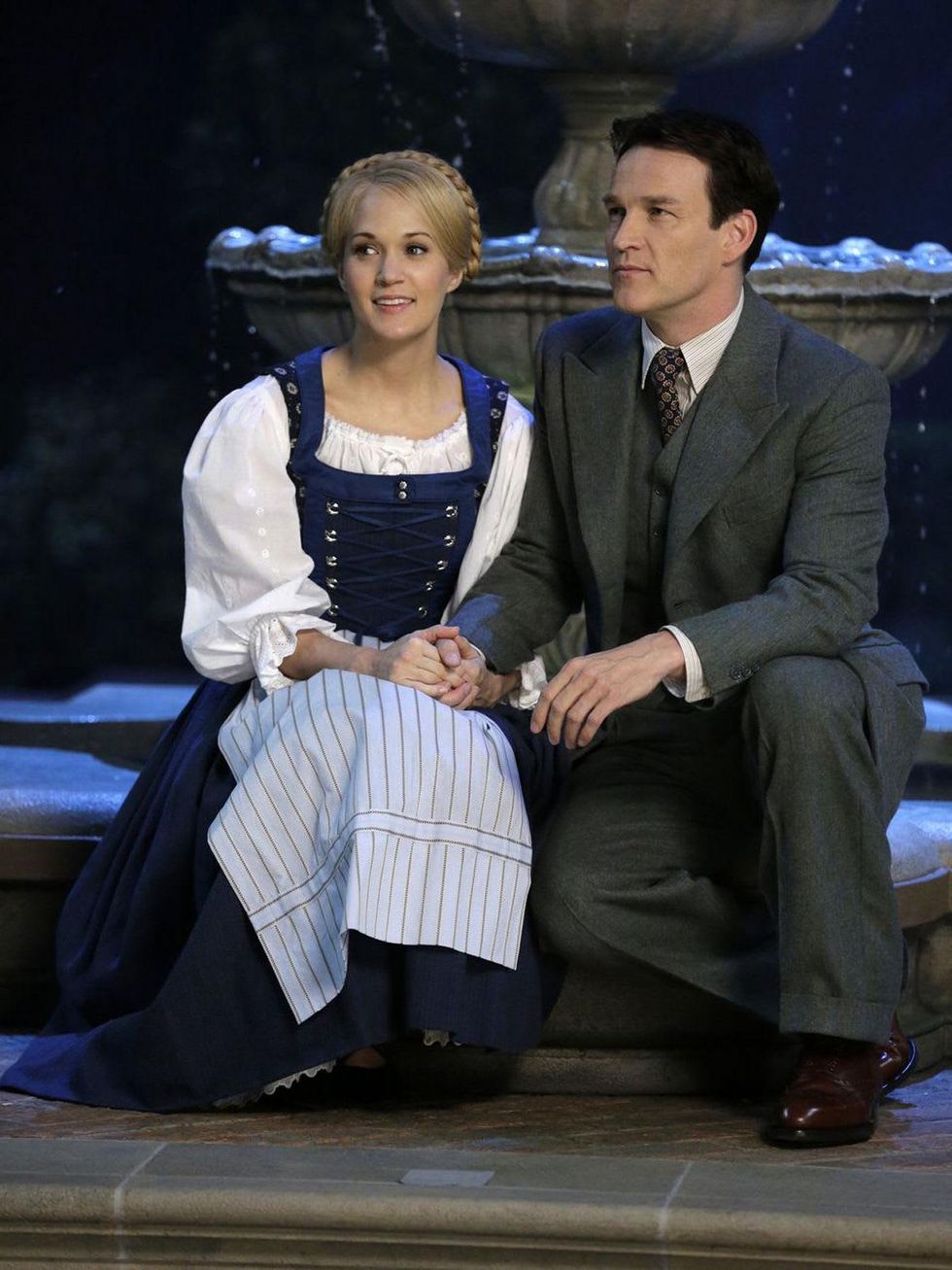
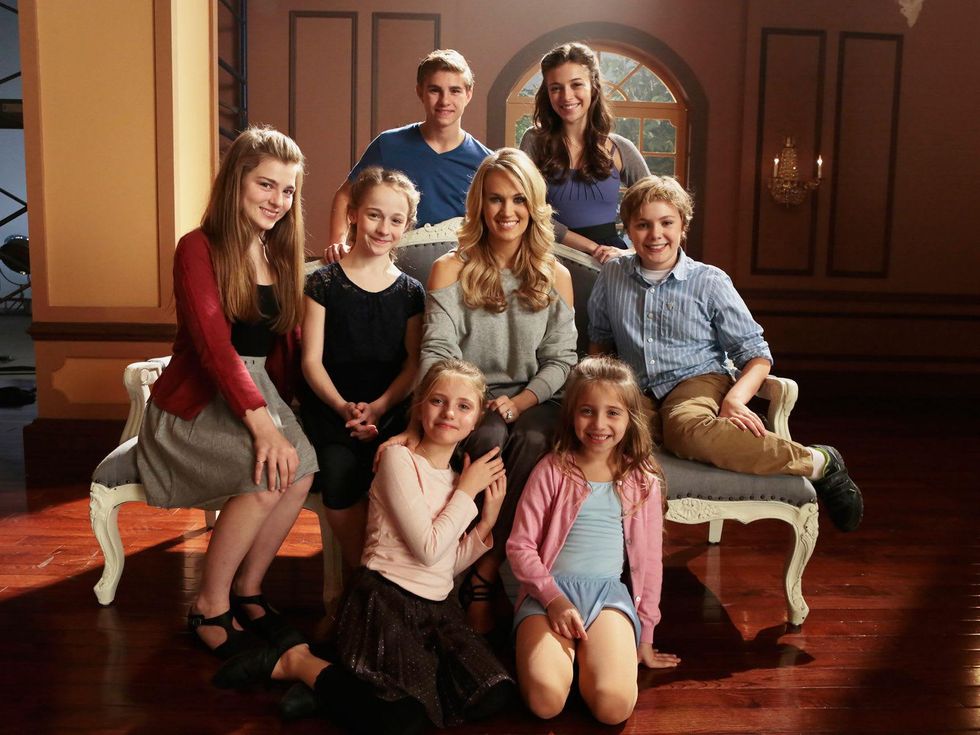
This is just one of many surprises in store from this hotly anticipated version of the Rodgers & Hammerstein classic, which stars Underwood as the effervescent nun in training, Maria, and True Blood’s Stephen Moyer as Captain Von Trapp, plus Broadway’s Audra McDonald (Mother Abbess), Laura Benanti (Elsa), Smash’s Christian Borle (Max), seven adorable kids and assorted nuns and Nazis.
“We’d never want to remake the movie,” says producer Neil Meron. “The movie’s perfect.”
What they have instead is a TV event the likes of which audiences haven’t seen in 50 years. And they’re hoping it may change the look of television.
Let's Start at the Very Beginning....
Back in the 1950s, live variety shows (such as Sid Caesar’s Your Show of Shows) and dramas were standard fare. Musicals, too. Mary Martin performed a modified version of Peter Pan live for NBC in 1955 and again a year later. Then came Cinderella, the 1957 Rodgers & Hammerstein musical written for TV, starring a perky British up-and-comer named Julie Andrews.
But with the advent of videotape, shows could be recorded, and the look of television changed.
Today, so-called reality TV festers on most channels, but Meron and his producing partner Craig Zadan feel we are wearying of it and that another change is in store. “Viewers are ready for something new,” says Meron.
They hope to bring back “appointment television,” that nearly extinct tradition of a nation's rushing home to catch a special show, enjoying a shared cultural moment and jabbering about it the next day with friends. Thanks to DVRs, it rarely happens anymore. Except for news and sporting events, primarily — which are live.
NBC has a lot riding on this one. The production boasts two directors (Broadway vet Rob Ashford, who worked with the cast on character, and Beth McCarthy-Miller, who has helmed live shows like Saturday Night Live), six lavish sets (Alps, abbey, and so on, constructed in a row, extending about half a mile inside a hangar-like building in Bethpage, Long Island) and 12 cameras (six to shoot a scene, as another six maneuver into position to shoot the next scene, a leapfrogging dance requiring rehearsal just like the actors).
Plus one popular, if inexperienced, star.
How Do You Solve a Problem Like Maria?
"I’ve always been up for a challenge,” says Underwood, who’s never performed in a musical. Not even in high school, back in Checotah, Oklahoma.
"My school was so small, we didn’t really have drama or things like that,” she says.
Still, the magic of this particular show is not lost on her.
“Whenever it came on TV, my mom and I would pop popcorn, curl up in bed and watch it together,” she recalls. “That was our thing.”
Moyer, who grew up in England, has similar memories.“I remember watching with my sister on cold winter days,” he says.
It turns out he sang early in his career (before his success in fangs) and connects with the show’s title. “It’s not some glib four words — the show is about the sound of music, how it can unlock people, change lives.”
The very fact the Twitterverse came alive after Underwood’s casting indicates how much fans relate to this tale.
“Maria is awakening to love and the person she’s meant to be, the Captain’s awakening to music and reconnecting with his children — it’s about people coming into their own, and I think audiences are always moved by stories like that,” says Benanti, who played Maria in the 1990s Broadway revival. “Plus there’s amazing music, adorable kids, and this political backdrop of one of the greatest atrocities in human history — it sort of has everything.”
Climb Ev'ry Mountain
So, OK, clearly that’s why Meron and Zadan picked this property for their TV experiment. But pulling it off live is risky.
"We’ve timed everything — costume and set changes — around commercials,” says music director David Chase. “They did it in much the same way back in the ‘50s.”
With one exception — the orchestra played live. Here, it’ll be pre-recorded. To hedge their bets, a pianist will play along for the entire show, so if the unthinkable happens and the orchestral track cuts out, the music will go on.
Even if all goes smoothly, the differences between the stage version and the film will keep audiences guessing. Like with these songs:
* “The Sound of Music”—Underwood will sing the opening verse.
* “I Have Confidence” — sorry, folks, it’s cut — it was written for the movie.
* “My Favorite Things” is not sung by Maria and the children, but Maria and the Mother Abbess. (“It enhances the relationship between those two characters,” Chase explains.)
* “The Lonely Goatherd" is sung by Maria to the kids in her bedroom, in place of “My Favorite Things.”
* “Something Good”— which they’re keeping, even though it, too, was written for the movie. “So many people love it, and the first time we went through the music it was clear Carrie so completely connects with it,” says Chase.
There are also two additional songs from the stage production sung by Elsa and Max, which flesh out the political subplot of the Anschluss — when Germany annexed Austria in 1938. “I’m sure people will say, ‘That’s not what they did in the movie,’ ” says Chase. “Hopefully they’ll say, ‘That not what they did — but that’s cool.’ ”
Carrie Underwood stars as Maria in NBC's The Sound of Music.