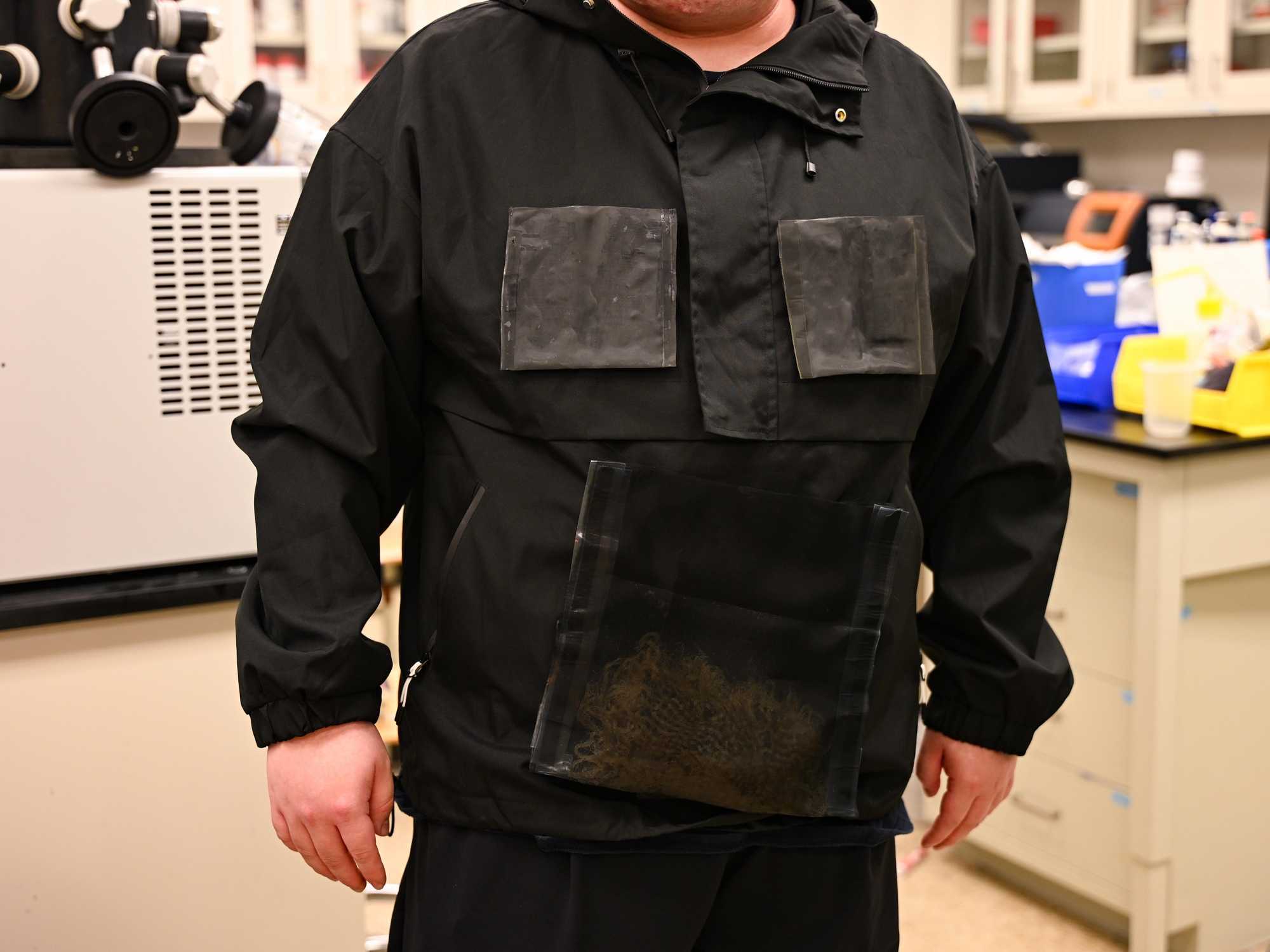
Engineers at the University of Texas at Austin have developed a prototype jacket that harvests clean drinking water directly from the atmosphere, and it works even in the driest desert conditions.
The research, published in Science Advances, marks the latest milestone in nearly a decade of work by materials scientist and chair professor Guihua Yu and his team at the Cockrell School of Engineering's Walker Department of Mechanical Engineering and Texas Materials Institute. The wearable technology marks a significant leap: instead of a bulky, stationary machine, this jacket does the work.
"We have been working on atmospheric water harvesting technology for a number of years," Yu says. "This current version is even more wearable. We're transitioning from conventional, more stationary water harvesting to something truly portable and personal."
Yu's lab first published work on hydrogel-based water harvesting around 2019, and the jacket is the latest evolution of that platform, now called AirGel. Last year, the broader AirGel invention won the top prize in the graduate category of the National Collegiate Inventors Competition.
The jacket is woven with specially engineered hydrogel fibers; ultra-porous materials that attract and absorb moisture from the surrounding air much like a household desiccant (like silica gel) does. Unlike a desiccant, the material doesn't require intense heat to release that water. The hydrogel is thermally responsive, meaning a modest rise in temperature — even from mild solar heating — is enough to release the water it has captured.
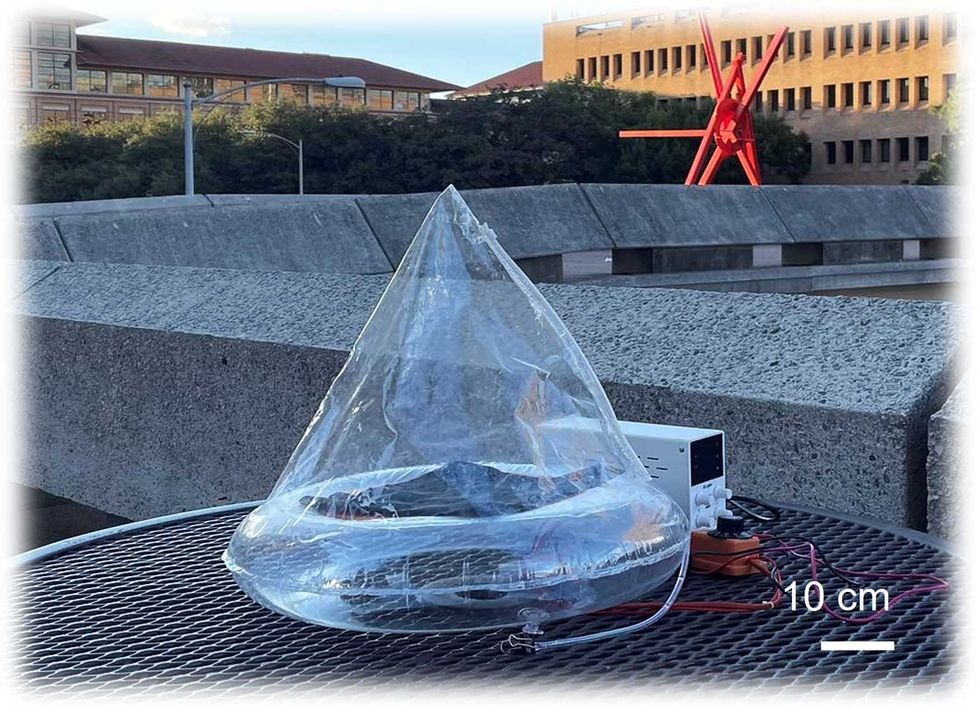 Testing out the condenser on U.T. campus in Austin. Photo courtesy of Chuxin Lei
So, somebody would be wearing the jacket, or perhaps carrying this gel-like textile as a blanket, as it passively absorbs moisture from the air. Then they would detach the textile panels and place them into a small, portable collector unit; essentially a compact heater. The water evaporates out of the textile, condenses inside the collector, and drips out as clean, drinkable water.
"It immediately becomes drinkable because it already goes through the distillation process," Yu explains.
In trials the jacket produced between 400 and 900 milliliters of water per day depending on humidity, or roughly 14-30 ounces, nearly a quart, depending on the air's humidity. With one kilogram of the textile, the researchers found they could generate approximately 3.7-4 liters of water in arid conditions, and potentially double that in humid ones. So far, the team has tried the jacket out in very dry, semi-dry, and humid areas, and the jacket was able to pull water from each climate.
Lead researcher Chuxin Lei, a postdoctoral researcher on Yu's team and co-author on the paper, says the goal was to rethink who this technology could serve.
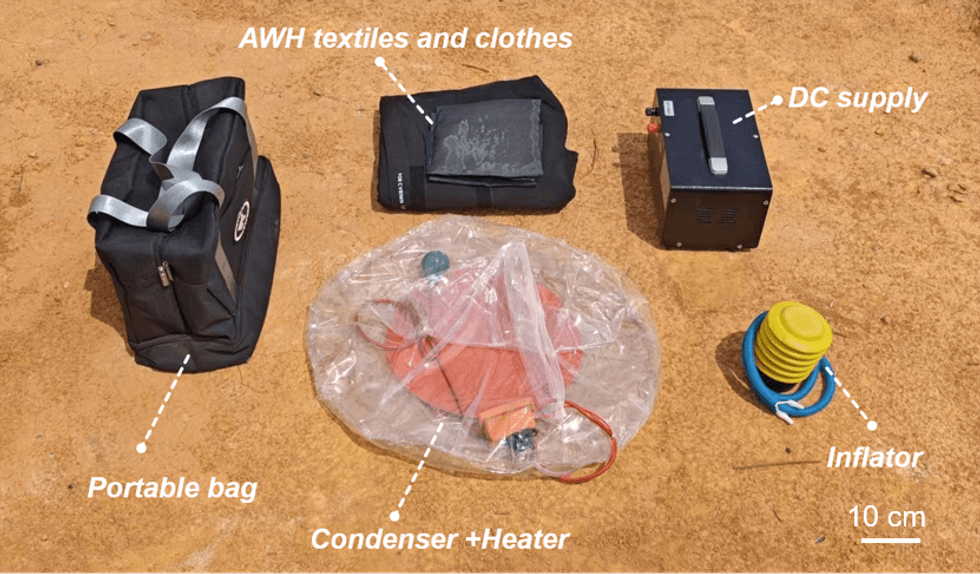 The various pieces needed to extract water from the jacket. The jacket is pictured in the top center, here, along with its removable textiles. Photo courtesy of Chuxin Lei
"Many current [atmospheric water harvesting] systems are still built as rigid or stationary platforms, making them less suitable for people who are moving, working outdoors, or operating in some remote environment. This lead us to ask whether we could build a water harvesting system that could become more like clothing — light, wearable, flexible, and naturally suited for personal use," Lei says.
The potential applications are wide-ranging. Yu's team has previously worked with the Department of Defense on water solutions for soldiers, where water logistics can be dangerous and costly. The technology could also serve hikers, emergency responders, disaster relief workers, and agricultural and field workers. Anyone who needs clean water on the go and far from infrastructure.
The team also sees a potential future where the technology complements large-scale centralized water systems rather than replacing them.
"Our solution cannot be a universal solution for all," Yu acknowledges. "But I think it's an extremely important alternative."
For now, the jacket is still a laboratory prototype, but Yu and Lei are optimistic. With the right industry partnerships, they say, the technology could realistically reach commercial scale within three to five years.