Even after a surprisingly bearable Austin summer, locals are taking to the streets to enjoy the newly arrived fall weather. Lest the novelty wear off in your immediate neighborhood, we're here with some ideas on where to stroll next.
Austin's citywide Walk Score — a standardized measure of how easy or pleasant it is to walk in cities across the U.S. — is a middling 42. This is not, on the whole, a pedestrian-friendly city. But spread across its sprawl are pockets where sidewalks are consistent, tree canopy is old enough to block the sun (which is still important well into fall, even if it's not hot enough to make walkers cry), and heading out for a pleasant walk doesn't require driving to a different neighborhood first.
Rather than rank every walkable neighborhood, we broke the city into 10 basic geographic areas and picked the neighborhood in each one that we think it feels nicest to walk in.
To judge each one, we looked at shade and tree cover, plus things worth looking at along the way (unique architecture, charming homes, gardens, nature, or window shopping); consistent sidewalks or at least wide and low-traffic roads; and places to stop for water or a snack. When available, we also considered small extras — namely Little Free Libraries, dog treat stations, and pet waste bag dispensers — that make a neighborhood feel considerate of walkers and their dogs.
Here are 10 places to walk while the weather is nice — and even when it isn't.
Central Austin: Hyde Park
Hyde Park has been walkable since it was established in the late 1800s, with a consistent grid offering sidewalks throughout and wide tree-lined streets. The neighborhood's well-preserved Victorian homes and craftsman bungalows give it some of the city's best historic architecture to look at along the way.
Quack's 43rd Street Bakery, Asti Trattoria, and Flightpath Coffeehouse are all within easy walking distance of most homes, and Shipe Park and the Elisabet Ney Museum's gardens offer shaded stops mid-walk. According to the Little Free Library world map, the area is littered with at least 10 book stations. That's the most we've seen in Austin.
West Austin: Clarksville
Clarksville has tons of old oaks covering most of the roads. There is often shade on one side of the street, because the neighborhood sits on a hill, so the sun is often at an angle that's blocked by buildings. The architecture is filled with old craftsman homes next to some beautiful, new modern houses. Sidewalks run throughout most of the busy roads — West Lynn, Blanco, 12th Street— and on the connecting smaller streets where they don't, the roads are wide and cars are few.
The neighborhood is dotted with dog bowls, two large, open parks with dog and human water fountains, and several cafés and two grocery stores on West Lynn, making all-important summer hydration very accessible. Clarksville has at least six Little Free Libraries right now, and several neighbors even set out dog treat stations. Public pet waste bags are dotted around the neighborhood, too, and West Lynn has shops for just about anything else.
North Austin: Crestview
Crestview has transformed from a sleepy collection of post-war ranch homes into one of the city's most walkable communities, without losing the shade trees and small-lot charm that made it appealing in the first place. Mature pecan, oak, and cedar elm trees shade lots throughout the neighborhood, and its uniform 1950s brick and wood-sided ranch homes — some untouched, some renovated — give the streets a consistent, low-key architectural character.
Crestview has seven Little Free Libraries and two public pet stations — one at Woodrow and Arroyo Seco; another at Arroyo Seco and St. Johns.
 This mural in Crestview is just one of the charming sites to see on a walk in this neighborhood. Crestview Neighborhood Association/crestviewna.com
Northwest Austin: Northwest Hills
Northwest Hills is built for a walk in nature, not a walk to dinner. Sidewalk coverage on residential streets varies, and most errands still require a car. However, the neighborhood does deliver an abundance of greenery, and it's lined with mature oaks for plenty of shade. It offers direct access to the Bull Creek Greenbelt's shaded, spring-fed trails, plus some of the best Hill Country views and limestone canyon scenery in the city, including panoramic overlooks at Mount Bonnell.
Neighborhood dining does call for a car trip, though some blocks sit close enough to nearby corridors for a walkable coffee run. Bull Creek's swimming holes are a popular stop for those days where the heat lingers. Northwest Hills has four Little Free Libraries, according to the map.
Northeast Austin: Mueller
Mueller was built specifically to be walkable, with sidewalks throughout and a mixed-use design that puts homes, shops, and restaurants in one constantly-buzzing jumble. Tree are strategically planted across this master-planned neighborhood, and even though trees are young, it's not so bad to have some light peeking through at this time of year. The architecture is also cohesive and charming.
Mueller Lake Park's walking loop anchors the neighborhood, and Aldrich Street's restaurants and cafés, plus a Sunday farmers market, keep refreshment close by. Mueller has nine Little Free Libraries and several dog stations throughout the park.
East Central Austin: East Cesar Chavez
The East Cesar Chavez neighborhood is based on a grid system with accessible sidewalks throughout. Mature trees provide shade for a colorful mix of old Victorian, craftsman, and modern homes, plus the neighborhood's many murals.
Along Cesar Chavez Street itself are a smattering of stops for refreshments or snacks for walkers. There are also several parks nearby like Comal Pocket Park, Pan American Neighborhood Park, and Metz Neighborhood Park, for more shaded areas to rest. East Cesar Chavez has four Little Free Libraries, and if you get close enough to the hike and bike trail, a couple of dog stations.
East Austin: Johnston Terrace
Johnston Terrace is a bit of a hidden treasure in East Austin — close enough to downtown to be convenient but far enough away to be quiet. With the Southern Walnut Creek Trail and the Boggy Creek Greenbelt, there's plenty of greenspace for a walk. Plus, just outside of the more residential area of the neighborhood is Springdale Road, with Austin Bouldering Project, Canopy Austin, Sa-Tén for coffee, and much more, all within walking distance.
South Austin: Bouldin Creek
Bouldin Creek has it all for walkers: it's lined with sidewalks, crosswalks, and wide roads. The houses are an eclectic mix of early-1900s bungalows and modern box-shaped additions, mostly fronted by some of the most lush and well-kept landscaping in Central Austin. Technically, Bouldin Creek even includes Auditorium Shores, so residents have easy access to one of the best parks in the city for both dogs and humans.
Aside from green space, Bouldin Creek also has plenty of stops for refreshments along the way: Bouldin Creek Cafe, Thai Fresh, 1st Food Mart, and more. Bouldin Creek has two Little Free Libraries and dog stations at Ricky Guerrero Park and Auditorium Shores.
Southeast Austin: Onion Creek
Onion Creek's winding streets are lined with mature oak trees, giving the neighborhood an established, shaded feel, even though it was only established around 50 years ago. That's young compared to some other Austin neighborhoods. The houses all look sort of like the stately house from Home Alone: lots of multistory brick and stone structures with big, sweeping, green lawns. Central to it all is Onion Creek Club's sprawling golf course. Plus, sidewalks and greenbelt trails run throughout the area, connecting to Edward M. Sullivan and Ballybunion Parks. Refreshments are hard to find in the immediate area, since Onion Creek is distinctly suburban, but it makes up for it with greenery and quiet.
Southwest Austin: Circle C
Circle C is a large, master-planned suburban community off of Slaughter Lane and Mopac, with smooth concrete sidewalks throughout and an active and very polished neighborhood feel. Cedar, cypress, and oak trees shade many of its streets, and its biggest draw for walkers is the sheer scale of connectivity. There are miles of dedicated interior hike-and-bike trails that link to local pocket parks, neighborhood pools, and the massive Circle C Ranch Metropolitan Park, a 500-plus-acre space with its own disc golf course, and soccer fields. It also contains The Veloway, a paved 3.1-mile loop reserved for biking and rollerblading.
Aside from public water fountains at parks, Escarpment Village and the Shops of Slaughter Creek handle refreshments. Casual sit-down spots like Waterloo Ice House handle food, with coffee and quick bites nearby. Circle C has six Little Free Libraries and several dog stations near trail entrances.


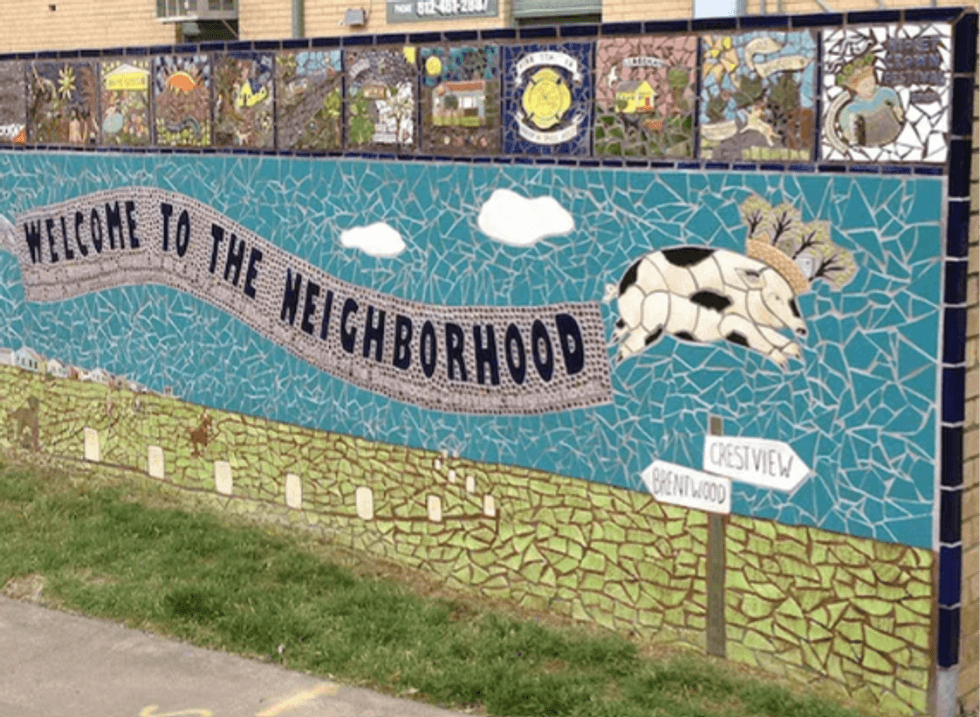 This mural in Crestview is just one of the charming sites to see on a walk in this neighborhood.