Just 12 years ago the Austin Lyric Opera (ALO) seemed on the road to expansion. To accommodate the staff needed to do that, ALO built a gorgeous, and immediately iconic building on Barton Springs Road.
But along with our economy, arts organizations have been feeling the fund-raising pain, the ALO among them. And on Friday it sold that building for $5.45 million to Megalomedia, a reality TV production company.
Things looked bleak for the Opera last spring. The ALO, a founding resident Long Center company, found itself up to its eyeballs in debt — as much as $2 million — and needed to make changes in order to survive. So they cut back their show runs from four to three, they put their headquarters up for sale and they will soon spin off the Armstrong Community Music School.
The building sale puts ALO back in the black. Its debt is paid and the proceeds place the Opera on solid financial footing. “We will spend the first quarter of 2012 locating rehearsal and office space and expect to be settled into new quarters well before summer,” Smith said in a press release Friday.
In the past quarter-century, ALO has developed a reputation as an innovator and showcase for new American opera talent, with productions that have fused with major international artists, directors, and designers garnered international acclaim.
Susan Threadgill, who was the production stage manager at ALO for 23 years recalls the early days of the company. "It was exciting and hectic. We had a great collection of professionals who knew their job very well, but didn't know each other very well. So we had to put together a team and make it work. There was a certain sense of trepidation because we had never done this before." But today, she says that singers have told her, "I sing at the Met to make money—but I sing in Austin to remember why I do this."
Claude Decloux, son of ALO co-founder Dr. Walter Ducloux, says that it was very important to his parents that the opera was not an "exclusive" club, not just for the rich, but something the community would take great pride in supporting. "He really believed, to the depth of his existence — both my parents did — that if people had the chance to see a first-class opera, they would get hooked on it. Because it is the ultimate art form and when you think about the number of orchestra members sitting in that pit, each of whom have played their instrument for 20 years… and then you have these incredible voices; it's just a synthesis of a million hours of talent, all in one place."
For his part, Artistic Director and Principal Conductor Richard Buckley is excited to look to the future of the Austin Lyric Opera. "Where the next 25 years are going to take us is something I hope people seriously start looking at. Within our celebration of what we have done and where we are, what we can and do achieve on the stage now, I think we have to put a fair amount of energy into who and what we want to be — and for whom will we be performing in the next 25 years."
The sale of ALO's headquarters makes that future possible. ALO's next production — Donizetti’s classic Italian opera Lucia di Lammermoor — opens January 28 at the Long Center.
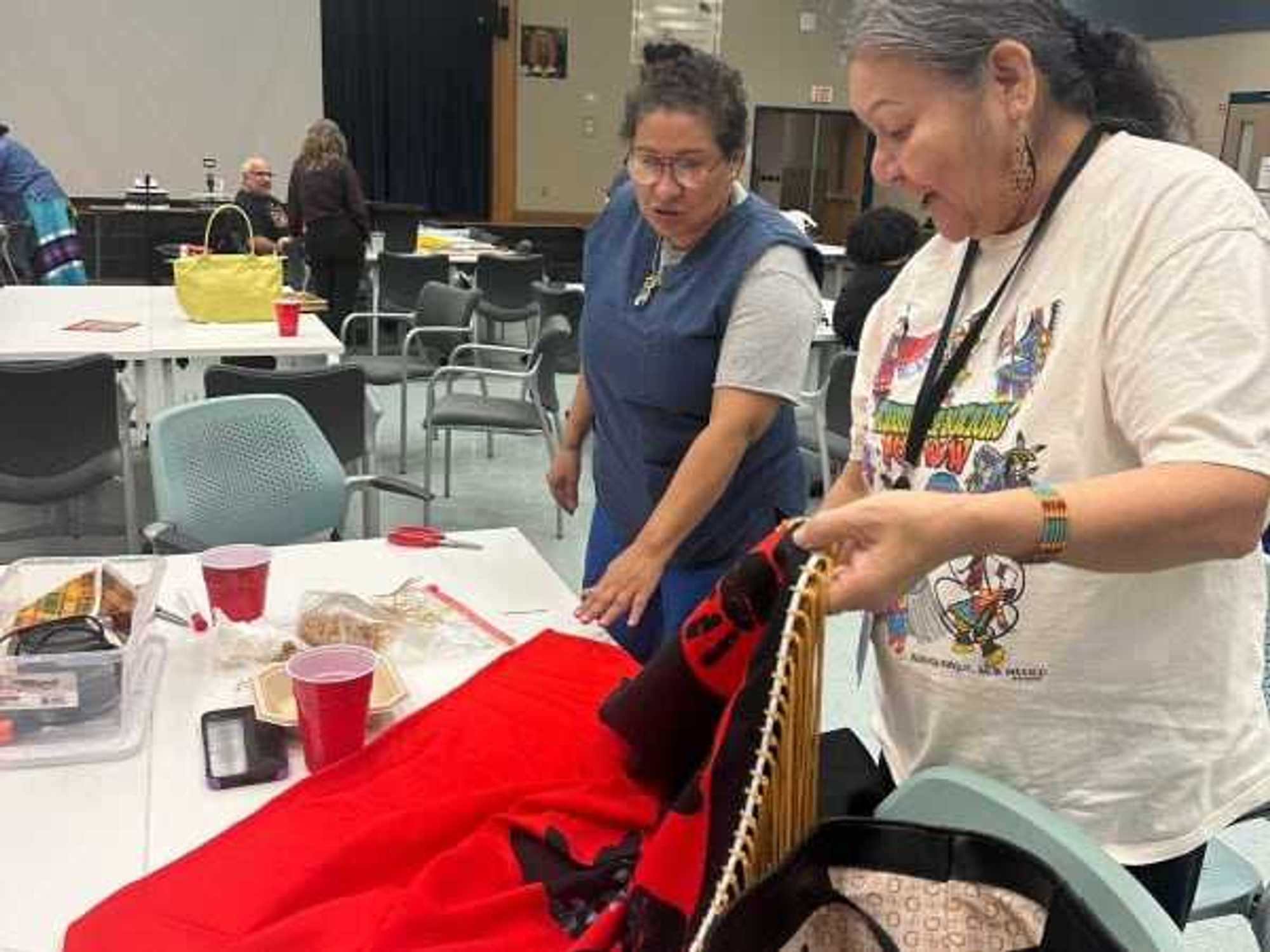
Skye King, right, works on a red fringed shawl for the Austin Powwow during Sew Indigenous at the former Metz Elementary in East Austin.
On a Wednesday night in November, Skye King and about three dozen others gathered at the former Metz Elementary in East Austin — now the Native American Cultural Center — to sew regalia for the Austin Powwow. The festival runs from 9 am to 9 pm Saturday, November 21, at the Travis County Exposition Center (7311 Decker Ln.).
The Native American Cultural Center moved to the former Metz campus this spring after the sale of its previous home at Brooke Elementary. The nonprofit is already looking for more room. It hosts regular luncheons for elders in a portable classroom without a kitchen, Austin Vida reported.
In May, Austin City Council voted 9-0 to create the Native American and Indigenous Quality of Life Commission. The commission advises the council on cultural preservation, economic development, education, health, and wellness. Its duties also include advising on the cultural center’s operations and development.
Council Member José Velásquez, who led the effort, told Austin Vida that Native and Indigenous residents had long been underrepresented in city policymaking.
Who Austinites dance for
As she sewed a red fringed shawl, King talked about a close friend’s daughter who went missing and still hasn’t been found. King believes she was taken. Her account touches on a broader crisis: The Bureau of Indian Affairs says Native American and Alaska Native communities have faced high rates of abduction and other violence for decades.
“So I’m going to dance for her, King says. "I’m going to dance for her.”
The group meets for Sew Indigenous, a weekly workshop at the center. Beginners and experienced makers work on ribbon skirts, beadwork, and other projects, sharing techniques as they go. The center encourages people to bring their own supplies if they can and keeps a few sewing machines on hand to share.
The center also puts on the Austin Powwow and Native American Heritage Festival, which dates to 1991. Organizers say the gathering draws more than 15,000 attendees and more than 300 dancers from different tribes and regions. The number of participating Native food vendors, artists, and craftspeople also surpasses 100.
Visiting the Austin Powwow
The market at the Austin Powwow opens at 9 am, the Gourd Dance begins at 10:30 am, and dancers enter the arena for the Grand Entry at noon. This year’s host drum groups are the Wild Band of Comanches and Meskwaki Nation. Competitions include jingle, grass, and fancy dancing, with divisions for dancers as young as 6 and a Golden Age division for dancers 50 and older.
At the outdoor Heritage Stage in the vendor market, Maxochitl starts the program at 10 am with children’s stories and poetry, followed by a potato dance competition at 11 am. The stage pauses for the Grand Entry and resumes at 1:30 pm with Jackie Salgado’s jingle dress showcase. Later performances include:
music by PHNX.WAV at 2:30 pm
the Hula Kalau Kaeepa Polynesian Dancers at 3:30 pm
danza led by Kalpulli Ayolopaktzin at 4:30 pm
flute and storytelling by Ryan Harjo at 6 pm
Organizers ask visitors to stand and remove their hats during the Grand Entry, flag songs, and honor songs. The dance arena is sacred space, and guests should enter only if invited. Attendees are told to ask dancers for permission before taking their photos or touching their regalia, beadwork, or feathers. Families can check strollers at the gate, since strollers are barred from upper-level seating.
Parking is free, and children 12 and under get in free. Online tickets cost $13.91 for ages 13 and up and $11.85 for military veterans, including fees.


 Photo by Mark Matson