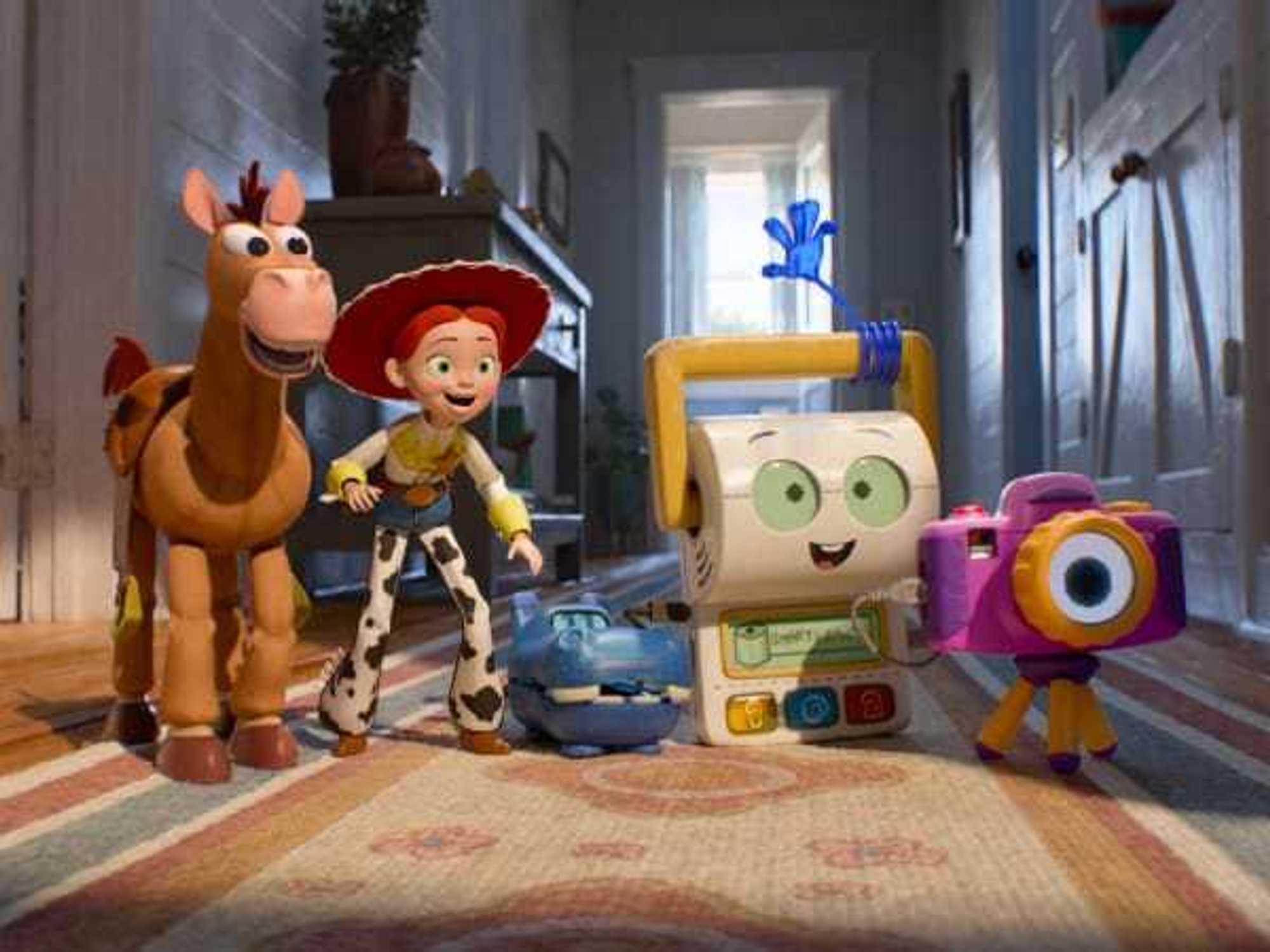
Bullseye, Jessie, Atlas, Smarty Pants, and Snappy in Disney and Pixar's Toy Story 5.
For fans of Pixar, the idea that it’s been over 30 years since the original Toy Story came out is a little mind-boggling. While the animation studio has had varying degrees of success with their other properties, they’ve always managed to make something special with each installment of their signature franchise. They’re now rolling the dice yet again with Toy Story 5.
The story is mainly focused on cowgirl toy Jessie (Joan Cusack), who — along with Buzz Lightyear (Tim Allen), Hamm (John Ratzenberger), Forky (Tony Hale), and others — is concerned that new owner Bonnie (Scarlett Spears) is falling prey to the scourge of technology in the form of the tablet Lilypad (Greta Lee). They’re worried that the “friends” she makes through games online pale in comparison to those she could play with in person.
Woody (Tom Hanks) and Bo Peep (Annie Potts), living an on-the-go lifestyle but still in touch with the main group, come to help when Jessie goes missing while trying to help Bonnie. And — just because — a large group of new-and-improved Buzz Lightyears that have fallen out of a shipping container that has crashed on an island go on a mission that puts them on course to meet up with everyone else.
Written and directed by McKenna Harris and Andrew Stanton, the film is a mixed bag, mostly because of the disjointed nature of the story. When the group was separated in previous films, things rarely felt out of sync as everybody was still heading toward the same goal. But the different factions in this film seem to be after something different, especially the wholly superfluous addition of the fancy Buzz Lightyears, whose ultimate purpose doesn’t live up to the time dedicated to them.
There’s no way around it: While Jessie is a good character and has a lot of great moments in this film, the relationship aspect of the series is not as strong this time around. She mostly spends time with her mute horse Bullseye, but even when she interacts with new characters like Smarty Pants (Conan O’Brien), that ineffable magic is not there. Woody and Buzz have scenes together, but since they’re secondary to the main story, they don’t add as much to this film as they have in others.
However, even if the film can’t live up to the first four movies, it still makes for a fun time. The storyline about technology turning kids (and adults, for that matter) into zombies is a strong one, and the way they incorporate different devices is clever. The large number of characters is unwieldy, but when the filmmakers truly dig down to the personal lives of certain toys or humans, the film is as effective as Pixar has ever been.
Cusack, Hanks, Allen, and other returning voices are so attuned to their respective characters that you know they’ll deliver each line perfectly. People like Lee, O’Brien, and Craig Robinson are welcome additions to the group, but it’s tough to get used to new voices taking over for actors who’ve passed like Don Rickles, Estelle Harris, and Carl Weathers.
The pitch-perfect ending of Toy Story 3 made the idea of Pixar making Toy Story 4 seem strange, but then that film proved the studio knew what it was doing. While Toy Story 5 is not a disaster, it’s not to the standard set by the previous films. It should finally be time to put the franchise to bed, knowing that the toys have given all the joy they can give.