There is an entire Internet subculture devoted to predicting the Oscars. It has its own Vegas odds-makers, like sporting events, and several different blogs devoted to handicapping the ceremony. Hard and fast rules don't work, and even renowned statistician Nate Silver wasn't as good at predicting who got little gold men as he was at predicting how the 2012 election would unfold.
No matter. If you followed my advice last year, you went with a consensus arrived at after several years of obsessive following of pre-Oscar indicators, gut instinct, and a resolution to not take it so seriously. You also got 18 out of 24 categories correct, which is more than enough to win the pool at most offices or Oscar party pools.
This year should be no different if you follow my foolproof guide to the Oscars. These are the winners wrought by the awards season narrative, and I'll be absolutely sure of each one — until a few of them are wrong on Sunday.
Argo has made a late season push to the front of the pack for Best Picture. Hollywood loves itself, so a movie about making movies (sort of) could swoop in and prevent the solid, but straightforward Lincoln from Mitt-Romney-ing its way to victory.
Argo should pick up Editing and Adapted Screenplay awards as well, while Lincoln consoles itself with wins for Daniel Day-Lewis and Tommy Lee Jones performances, and Steven Spielberg's direction. In the other major categories, Jennifer Lawrence wins Best Actress by a nose for Silver Linings Playbook, while Anne Hathaway wins Best Supporting Actress in a landslide (pretty much just for singing the Susan Boyle song from Les Mis, which will also win Sound Mixing for its innovative live-singing production). In a wide-open race, Django Unchained stands poised to take Original Screenplay.
Life of Pi should take a bunch of technical awards for looking pretty — mark it down in cinematography, art direction, visual effects and throw in Best Score as a bonus. Skyfall will become only the third Bond movie to win an Oscar, taking home both Sound Effects Editing and Best Original Song for Adele's titular ballad. Anna Karennina easily wins Best Costumes, and The Hobbit wins makeup for dusting off the hobbit-feet.
That leaves Wreck-It Ralph winning Best Animated Feature, Amour (a Best Picture nominee) easily winning Best Foreign Language Film, Searching For Sugar Man taking Best Documentary, and finally the unpredictable short films. Getting one short film right is a good day: at least Paperman (a partially hand-drawn industry favorite) is a lock for Animated Short. I have gone with Curfew in Live Action Short (it has a cute little kid), and Mondays at Racine (it's about cancer) in Documentary Short.
Without further ado, here's my comprehensive guide to the Academy Awards. Best of luck! And if I'm way off, I promise all of your money back.
Picture: Argo Director: Steven Spielberg, Lincoln Actor: Daniel Day-Lewis, Lincoln Actress: Jennifer Lawrence, Silver Linings Playbook Supporting Actor: Tommy Lee Jones, Lincoln Supporting Actress: Anne Hathaway, Les Miserables Original Screenplay: Django Unchained Adapted Screenplay:Argo Editing:Argo Cinematography:Life of Pi Score:Life of Pi Song: "Skyfall" by Adele from Skyfall Art Direction:Life of Pi Costumes:Anna Karennina Sound Mixing:Les Miserables Sound Effects Editing:Skyfall Makeup: The Hobbit Visual Effects: Life of Pi Foreign:Amour Animated Feature:Wreck-It Ralph Doc Feature:Searching for Sugar Man Doc Short:Mondays at Racine Animated Short: Paperman Live Short: Curfew
Life of Pi should take a slew of technical awards.
Photo courtesy of Life of Pi Flickr page
Life of Pi should take a slew of technical awards.
There are relatively few actors who can switch back and forth between comedy and drama easily, but Adam Scott is the rare exception. He’s equally well known for starring in comedy projects like Parks & Recreation, Party Down, and Step Brothers as he is for dramas like Big Little Lies and Severance. He’s going the latter route again in the new horror film, Hokum.
Scott plays author Ohm Bauman, who’s trying to finish his latest book. In an effort to avoid distractions and also pay tribute to his parents, he retreats to an Irish hotel where his mom and dad spent their honeymoon. Bauman, who is about as stand-offish as you can get, and the staff of the hotel are at odds almost right away, although Bauman finds a kind of kinship with Jerry (David Wilmot), a seemingly-homeless man he meets in a nearby forest.
Bauman becomes intrigued with the story of the hotel’s closed-off honeymoon suite, which is said to be haunted. His curiosity, though, seems to trigger a variety of strange things, one of which ends with him in an extended stay at the hospital. He returns to the hotel determined more than ever to discover what’s really happening in the honeymoon suite, with things both normal and supernatural blocking his way at every turn.
Written and directed by Irish filmmaker Damian McCarthy, the film’s approach to horror is both subtle and overt. On the good side is Bauman’s story, which gradually gets deeper as more is revealed about his past, especially the premature death of his mother. Bauman’s trauma over her loss influences his thinking and actions, and a possible connection between his current situation and his personal history broadens the scope of the plot.
There is plenty of creepiness to be found in the film, starting with the dark and decrepit nature of the hotel itself. Any building where a particular room is off-limits naturally inspires intrigue, and McCarthy does a solid job of building tension. That’s why it’s strange and disappointing that he gives in to the lamest of horror tropes — a sudden appearance by an odd-looking person accompanied by a big screeching noise — on multiple occasions.
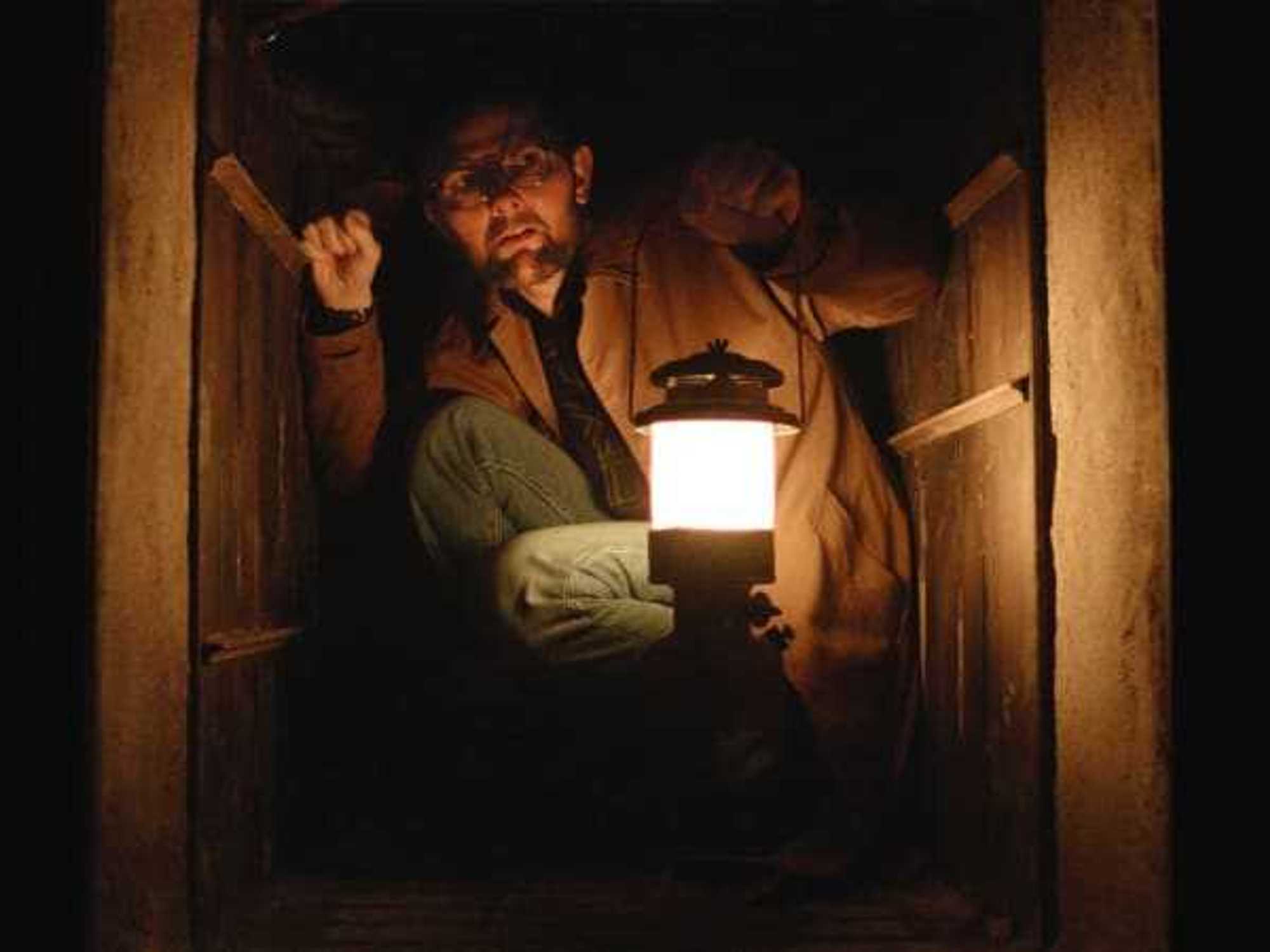
The film is at its best when it features weird moments that are never or only slightly explained. A dead body in a rabbit suit is echoed by the unexplained broadcast from Bauman’s youth featuring a terrifying TV host with bulging eyes and rabbit ears. Bauman’s explorations take him into the hotel’s basement via a dumbwaiter, where he encounters all manner of strange things, including what seem to be witches. Because most of these things are left to the audience’s imagination, they hit harder in the moment.
Scott is known to be understated in his acting, and that skill works well in this particular role. Although he clearly plays Bauman as freaked out, he never indicates panic, and that level-headedness makes his character someone you want to follow no matter how dark the path might be. The mostly-Irish supporting cast is not well-known, but Wilmot and Florence Ordesh make the most of their short time on screen.
Hokum — a title that is also not explained — is a horror film that earns its bona fides through mood more than action. Even though not much of consequence happens throughout the film, it still keeps you on the edge of your seat trying to figure out what will happen next.