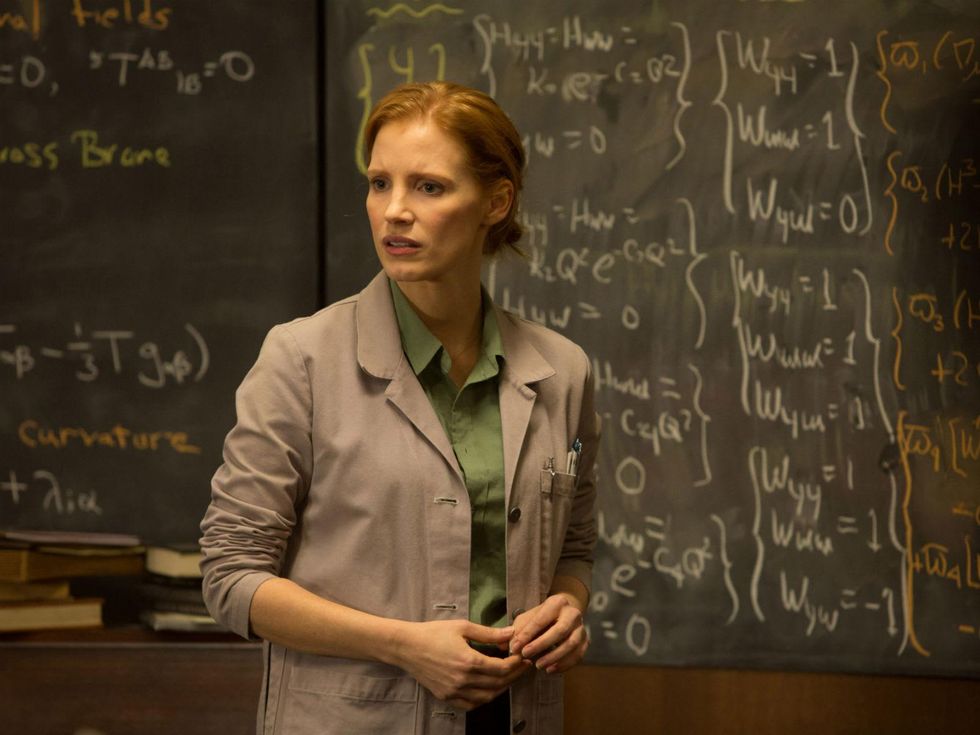
Director Christopher Nolan has never been the type to take it easy on anyone who watches his movies. From his early works like Following and Memento all the way through his Dark Knight trilogy, Nolan has filled his films with complicated ideas and fuzzy moral compasses.
However, his latest, Interstellar, may take the cake when it comes to his brand of hyper-intelligent moviemaking. It is a sprawling, nearly three hour trek filled with complicated ideas about space travel, Einstein’s theory of relativity, food shortages and other things that makes Memento easy to understand by comparison.
While the Nolan brothers do their best to keep the dialogue accessible to non-science geeks, it’ll be the rare moviegoer understands the entire movie the first time around.
At its center is Cooper (Matthew McConaughey), a former NASA pilot now toiling as a corn farmer in order to help alleviate a worldwide food shortage at an indeterminate point in the future. With the human race threatened by extinction, Cooper is recruited to lead a mission to the farthest reaches of space to find a world that will save the species.
Nolan and his brother, Jonathan, who co-wrote the film, disorient the audience right from the start with things that are familiar yet foreign at the same time. Were it not for the constant dust storms and things like the New York Yankees playing home games in a run-down stadium in the country, the world they put forth could almost be our own.
Once the action goes into space, things really start to get complex. While the Nolan brothers do their best to keep the dialogue accessible to non-science geeks, it’ll be the rare moviegoer who proclaims that they understood the entire movie the first time around. As the crew, which includes Anne Hathaway, has to deal with wormholes, black holes, time slowing down and other factors, there’s a lot of jargon to wade through.
Were this film done by any other director but Nolan, the race to find a new habitable planet would be the overriding plot arc. Even though it’s still arguably the main focus, the film makes plenty of time for other storylines, social commentary and other plot points. The film is less a thriller and more a meditation on human relationships and desires.
The biggest issue is that what is supposed to be the film’s biggest bond, between Cooper and his daughter, Murph, never really gels. The film has so much going on that the heartbreak Murph suffers when Cooper leaves on his voyage doesn’t get a chance to truly register.
From a visual standpoint, Interstellar does make an impression. Although you don’t get the “you are there” feeling of Gravity, Nolan and his crew make sure to give a sense of wonder to traveling through deep space. They also amaze with blocky, sentient robots that move with a grace that is unexpected, and who are as helpful to the cause as any human.
Interstellar is one of those films you will be thinking about long after you leave the theater, but on a purely visceral level, it doesn’t measure up to some of the year’s best. It could be a film that improves on second and third viewings when worrying about the details of the story becomes less important, but few will have the opportunity to do so.
Matthew McConaughey explores deep space in Interstellar.

Photo by Melinda Sue Gordon
Matthew McConaughey explores deep space in Interstellar.
The "Choosin' Texas" music video was shot on location at Fort Worth's Stagecoach Ballroom.
Ella Langley’s “Choosin’ Texas,” a simmering, midtempo, country-and-then-some heartbreak song released last October, is indisputably 2026’s biggest hit.
“Choosin' Texas” is also the longest-running No. 1 hit in the U.S., having spent 23 weeks at the top spot on the all-genre Billboard Hot 100, it was announced Tuesday, September 22.
That means the track has surpassed various records set by Shaboozey’s “A Bar Song (Tipsy),” Lil Nas X’s “Old Town Road,” Whitney Houston’s “I Will Always Love You,” and most impressively, Mariah Carey’s “All I Want For Christmas Is You.” Her holiday classic held the previous record, with 22 weeks at No. 1.
The song’s laid-back sound, cross-genre appeal and heartache narrative are a few reasons why. It comes with a well-produced, star-studded music video that was shot on location at Fort Worth's Stagecoach Ballroom earlier this year.
But its dominance still comes as a surprise.
Here’s how huge it's become Luminate, the industry data and analytics company, found that “Choosin’ Texas” brought in 911 million on-demand streams in the U.S. and 1.26 billion globally as of mid-August. Considering that Langley started 2023, around the time she made her Grand Ole Opry debut, with under 1 million monthly listeners on Spotify — and now boasts of over 32 million — her rise has been meteoric.
Historically, country listenership has centered on radio play. That has changed somewhat as the genre grows in popularity, solidifying around what Luminate’s Jaime Marconette describes as a “younger, streaming-forward listener.” He says it is a “multiyear narrative accelerated” by hits like “Choosin’ Texas.”
Claire Heinichen, a senior editor at Spotify, says the song’s growth has been both explosive and consistent. “Choosin’ Texas” “started big,” she says, moving from the platform’s leading country playlist, "Hot Country," to its larger, generic offerings because it works across audiences.
“It made its way into ‘Today’s Top Hits,’ which is our biggest global flagship playlist, but it’s also showing up in ‘Mood’ and ‘Moments’ playlists because it fits so well in ‘driving’ or ‘chill’ or ‘cookout,’” Heinichen says. “It really can work everywhere.”
It’s not just country music fans who are connecting with “Choosin’ Texas.”
“The song’s success on a playlist like "Today’s Top Hits" is an indication that this is working for audiences who are not seeking out one specific genre,” Heinichen says. “It’s definitely growing in every direction.”
Ella Langley's voice has something to do with the song's success. Photo courtesy of Ella Langley
The specific sound Go straight to Langley’s voice for another explanation for the song’s success. It’s “like syrup,” says Nate Sloan, a musicologist, assistant professor at the University of Southern California and co-host of the podcast Switched On Pop.
She sings in long phrases that lull the listener into the song’s rhythm, from its opening guitar line to its coda. “It’s almost like a trance,” Sloan says.
It also pulls from other genres; a cross-pollination found in much modern country. Langley’s “Choosin’ Texas” features shimmery disco grooves, not unlike Kacey Musgraves.
“It’s a little more rock or even kind of soul-inflected,” Sloan says. “Part of the reason songs like ‘Choosin’ Texas’ are able to resonate with such a wide audience is because, musically, they’re bringing in a lot of diverse influences.”
Charles L. Hughes, a Rhodes College professor and author of Country Soul, says the song sounds like many different eras of country music and, simultaneously, contemporary.
To his ears, “Choosin’ Texas” pulls from a late 1970s, early ’80s era of country musicians who pulled R&B and pop into their sound — think Ronnie Milsap, Barbara Mandrell and Charlie Rich — but it isn’t stuck in that period. Those sounds are filtered through a post-Musgraves, post-Miranda Lambert songwriting style, with Langley’s idiosyncratic charms. (Lambert and Langley are two of the song’s four cowriters.)
“The best country music has one foot in the past and one foot into the present, if not the future,” Hughes says. “And that’s what she’s doing.”
Even for its light, bright musicality, “Choosin’ Texas” is an unusual hit, because it doesn’t possess the features that historically make up a No. 1 smash. It’s super specific — with its detailed descriptions of characters and geography in the lyrics — which is “antithetical to what you usually expect from a big, hit pop song that’s supposed to appeal to everyone,” says Sloan. It’s also “chill,” Sloan says. “It’s not bombastic or anthemic.”
“It has no big moments,” says Hughes. But it has both a subtle dance pulse and steel guitar, so “it sounds country, but it doesn’t automatically turn off people who are allergic to certain kinds of country sounds.”
There’s a sparkle that transgresses genre lines, but it does so while sounding mellow — the kind of track that inspires repeat listens.
Appeal of the lyrics “Choosin’ Texas” continues a great tradition of “songs that country women do about what men do in bars,” says Hughes.
It’s straightforward: She’s losing her lover to someone else. She’s not going to fight for him — it’s a song of resignation that ends with her drinking alone as he chooses Texas (another woman) over her (and Tennessee). It’s a universal heartbreak theme with potential for cross-generational resonance: It works for both the insecurity of a first breakup and a long-term relationship ending over another woman, or a move.
“It’s got these great turns of phrase that give you a little bit of ironic distance as a narrator and as a listener,” says Sloan.
“It doesn’t take a crystal ball to see,” Langley acquiesces in the chorus, “A cowboy always finds a way to leave.”
The lyrics are also clever, standing out in contemporary country, says Hughes. (Compare it to Luke Bryan’s “Fish Hunt Golf Drink.”) And it’s detailed: Langley’s paramour loves George Strait’s “Amarillo by Morning,” a pantheon Texas track; she’s drinking Tennessee whiskey as a result.
“There is the phenomenon of what some critics have called 'the sad banger' within the world of pop music,” says Sloan. In country, it’s even more common to take something sad and transform it into something funny or deadpan. “And that’s what she’s really good at, at this song.”
What it says about 2026 music The fact that regular chart-toppers like Taylor Swift, Morgan Wallen, and Bad Bunny haven’t released new albums this year could’ve cleared a path for the dominance of “Choosin’ Texas,” but Sloan sees its rise as indicative of something else.
“We’re in this environment where you can measure a song’s success in a numerical way,” he says. “But then in terms of its actual cultural impact, that might be more fragmented than you think.”
Essentially: “Choosin’ Texas” is on top. But how many people know Langley’s name, the way they knew Houston’s and Carey’s when those hits were released?
“It doesn’t feel like a centerpiece of a monoculture, but it is absolutely a key part of like radio culture, streaming playlists, TikTok,” Hughes adds. “But it’s hitting these various audiences in a way that combines to create something huge.”
But what does it forecast for Langley? She’s no one-hit wonder: Her award-winning 2024 collaboration with Riley Green, “You Look Like You Love Me” is evidence of that.
“It’s always hard to prognosticate with artists when they have an unexpected smash,” says Sloan. “Her ability to write songs with a lot of integrity that both reach back into country tradition and incorporate sounds of the 21st century? That’s a pretty good formula to have a successful and long career in the music world.”