An Austin group is committing to their own style of cumbia on their debut LP. The Animeros will release ¡Qué Bárbaro!, produced by Dan Auerbach of the Black Keys, on August 28. They'll introduce the album at two local shows August 27 and 28 before heading out on a headlining West Coast tour.
The Animeros are guitarist Mauro Lopez, bassist Nicolas Sánchez, and drummer and percussionist Nick Tozzo. All three have played with one of Austin's leading Latin groups, Superfónicos; Sánchez and Tozzo were previously part of the group, and Lopez plays with them now.
Though fans of Superfónicos will likely enjoy The Animeros and vice versa, The Animeros are a much smaller band, which was one of the initial reasons to form the group. The leaner membership achieves a more focused sound — a type of cumbia nouveau that's capacious, but not sparse, where each well-placed part emerges more fully from the combined sound. A press release calls it a "visceral, muscular take on cumbia," which allows for more exploration.
The "muscular" sound is more an issue of assertiveness than, say, intensity or masculinity. Whereas cumbia, the Afro-Latino Colombian dance tradition, very often succeeds at creating a lively, steady base to settle into on the dance floor, The Animeros excel at painting a picture.
Flourishes so winkingly tropey that they are essentially spaghetti Western sound effects emerge; later they're superseded by Santana-like guitar solos. The band credits Quentin Tarantino and other 90s directors, plus images of West Texas, for triggering their songwriting imaginations.
“I really do think that the album sounds not only like it's from Texas, with the spin that we do, but a lot of it is just influenced by Austin," says Lopez, who hopes listeners can pick up on the regional flair. "We go see our friends who are also playing in Latin groups, but we [also] watch every other band. You know, we're at the White Horse, and we go to rock clubs and punk shows.”
Just as Lopez, Sánchez, and Tozzo did not specifically aim to be a Superfónicos spin-off, they also neither emulated nor eschewed traditional cumbia. They explain that growing up with their parents' record collections — spanning rock, cumbia, and more — influences merged in their musical minds.
"We love traditional cumbia and other traditional Latin styles," says Lopez. "That's where all of this begins. And the foundation of our sound is based on those traditional styles — particularly percussion rhythms. But our broad array of influences outside of Latin music finds its way into the music. This wasn't necessarily intentional at first, but it became apparent as we shaped our sound and style."
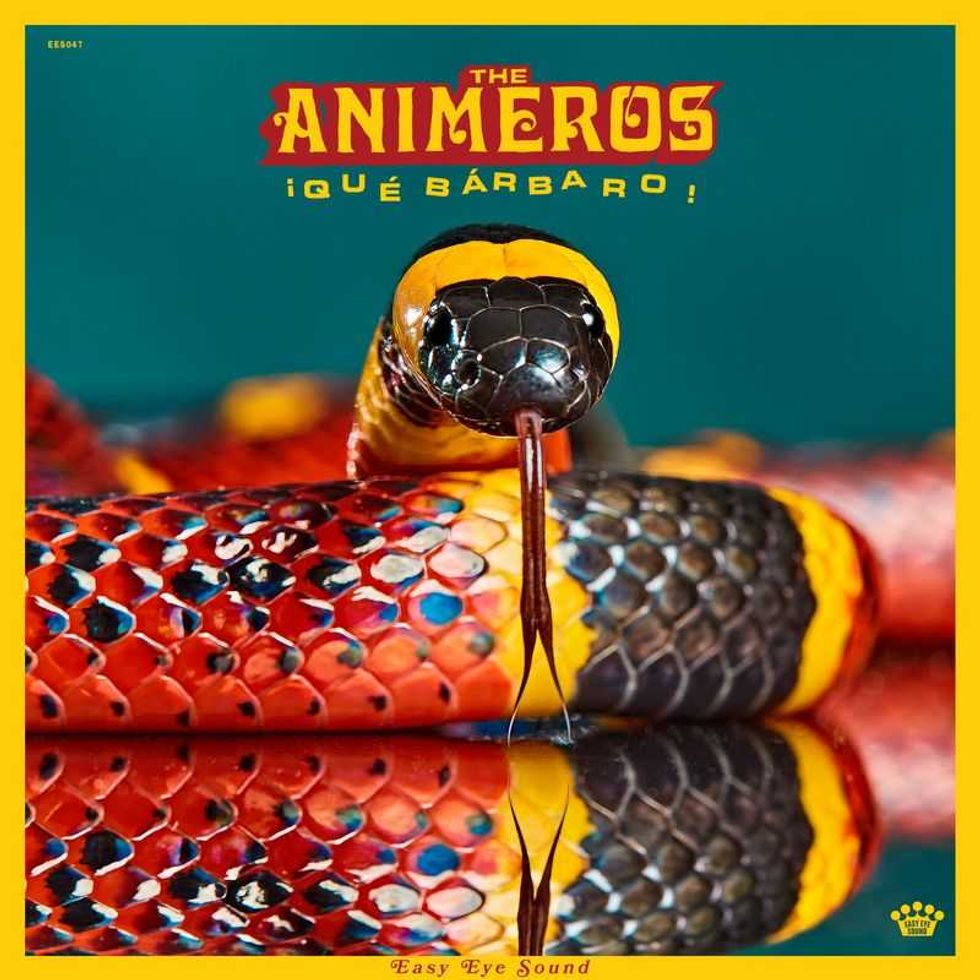 ¡Qué Bárbaro! by The AnimerosAlbum art courtesy of Easy Eye Sound
The connection with Auerbach, who reached out to the band after attending their second show ever, also brought new sounds to their attention. They were surprised to find that Auerbach knew some deep cumbia cuts that they'd never heard, and he approached the band as a genuine fan, without trying to change much of their sound.
By the time Auerbach got in contact with The Animeros in April, they'd already recorded a four-song EP, but they weren’t sitting on much new material. The band went to Nashville to record in June, giving them about a month and a half to write some songs. They thought about half would be viable, but Auerbach ended up liking more than that. The final album draws together 10 originals and three covers.
The Animeros agree that Auerbach's guidance was most useful in tweaking the band's live sound to remain full and lively on a record. His four walls of guitars and impressive vintage keyboard collection also played a part in refining this studio sound, and the blues guitarist even jumped in to feel out some specifics, like trying out different pedals.
As musicians and even keen listeners could probably guess, the band "writes" while playing live. It starts with an idea in sound check and they develop it from there. They are still, foremost, a live band, and fans of the album can rest assured that the music only gets better in a club.
“[We] really loved ... going into the studio instead of doing a super polished, track-by-track, 100 percent overdub," said Lopez. "So yes, we are a live band. We love playing live, and this album I think captures some of that live energy just because [of] the nature of how we recorded it.”
That locked-in live feel especially comes out in the middle of ¡Qué Bárbaro!, on especially danceable tracks like "Descarga Royal" and "Ponchote de Ritmo." Earlier tracks like "Gózalo" and "Terlingua" plunge the album into its signature cinematic mood right away, and the slow and stately "Al Final del Camino" returns, playing out the album with emotive strings as if in a desert scene as credits roll.
Although the band certainly seems to be carving out a niche, Austin listeners are well prepared to meet them with enthusiasm.
“Austin responds really well [to cumbia]," says Tozzo, pointing out that listeners come ready to dance. "I mean, obviously Grupo Fantasma started here in the early 2000s, and those guys — in addition to being great friends of ours and mentors in many ways — but those guys primed this city and ... really exploded the mindset of cumbia rock and cumbia funk in this town."
Austin fans can catch The Animeros at Waterloo Records on Thursday, August 27, and the Continental Club on Friday, August 28. After that, they'll embark on their nine-stop West Coast tour, with stops listed below.
¡Qué Bárbaro! will be available to stream August 28. Vinyl records, CDs, signed copies, and band merchandise are available through The Animeros' online shop.
The Animeros Headlining Tour Dates:
08/27 - Austin, TX - Waterloo Records, In-Store (5:30pm)
08/28 - Austin, TX - Continental Club (Album Release Show)
9/30 - Santa Fe, NM - Tumbleroot
10/01 - Phoenix, AZ - Linger Longer Lounge
10/02 - Yucca Valley, CA - Dune Room
10/03 - Los Angeles, CA - Zebulon (KCRW Presents)
10/06 - Santa Cruz, CA - Moe's Alley
10/07 - San Francisco, CA - Brick & Mortar
10/09 - Portland, OR - Bunk Bar
10/10 - Trout Lake, WA - Trout Lake Hall
10/11 - Seattle, WA - Hidden Hall
11/03 - Oklahoma City, OK - Resonant Head
11/04 - Kansas City, KS - Bottleneck
11/07 - Minneapolis, MN - 7th St Entry
11/09 - Milwaukee, WI - Cactus