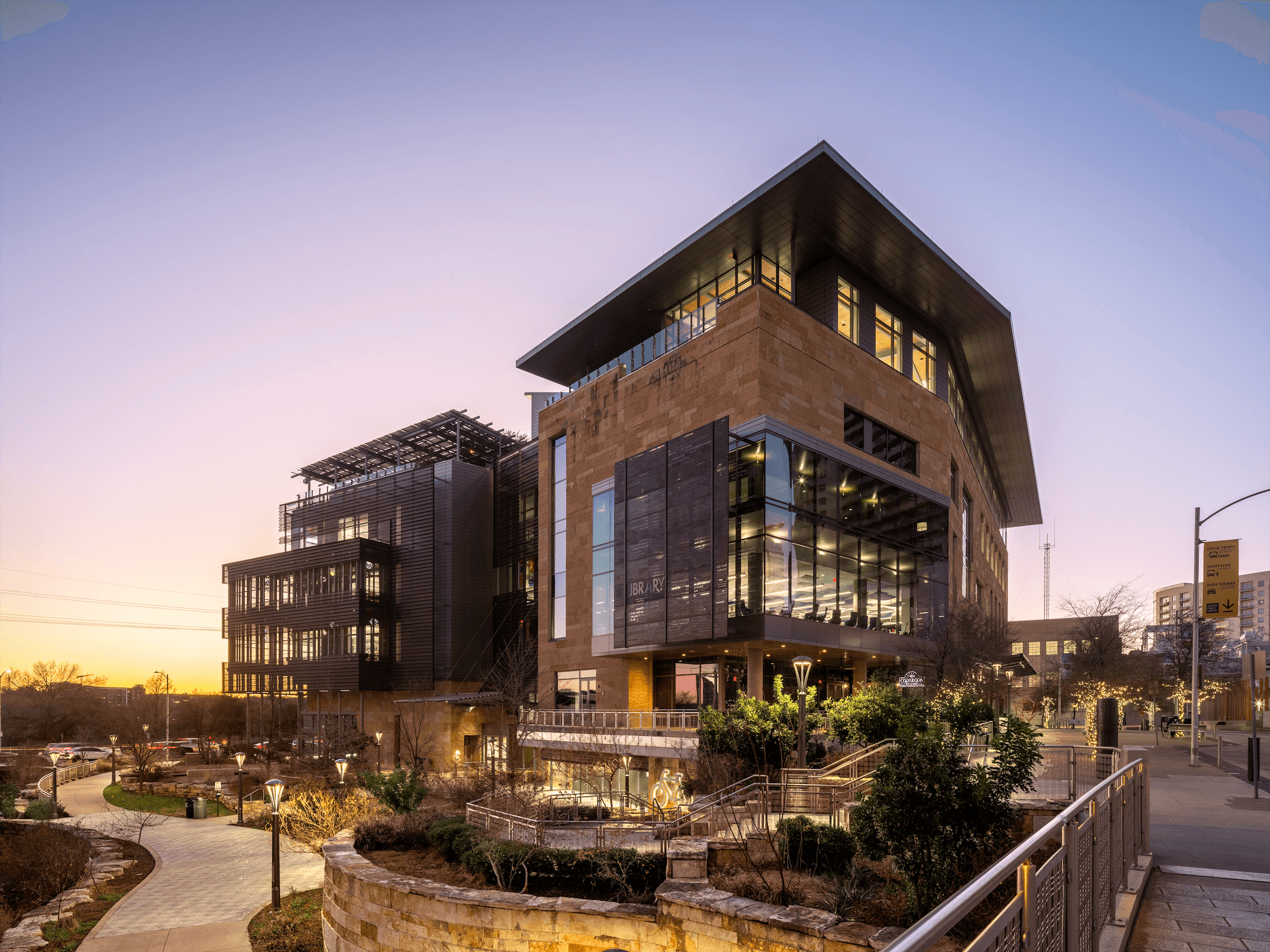
As Austin has grown, it's seen its fair share of contentious buildings crop up downtown. It's hard to find a legitimately popular downtown building, but the Austin Public Library (APL) has pulled it off with its Central location. The library is now featured glowingly on a poetic new Time Magazine list, "A Portrait of America in 25 Buildings and Monuments."
The new Time list, published June 2 and celebrated by the library June 10, pays tribute the 250th anniversary of the United States through a series of landmarks — anything from buildings to common neighborhood structures — each chosen to express something American. The magazine tasked 25 "architects, urban planners, thinkers, and other experts," it says, to choose a structure "that they believe says something special about the nation at this moment."
Time has expressed love for the Austin Central Library before. It named the library one of the World's Greatest Places when it was new in 2018. This time, it attributes the nomination to Eric Klinenberg, professor of sociology at New York University and author of Palaces for the People: How Social Infrastructure Can Help Fight Inequality, Polarization, and the Decline of Civic Life. Klinenberg looks at the Central Library through a similar lens and concludes it's getting a lot right.
"This stunning building, a palace for the people set along the Colorado river in central Austin, is, like all public libraries, a gift that local residents gave to themselves, and one that gives back every day," Klinenberg writes. He briefly mentions funding and turns his focus back to the social benefits.
"[T]he library serves as a civic hub, an antidote to social isolation, a play space, an ecological refuge, and, above all, a reminder that American communities are still capable of producing extraordinary public goods," he writes. "It's a model of the social infrastructure that Americans want and deserve, precisely what we need to rebuild an open society and democratic culture in this dark and dangerous moment."
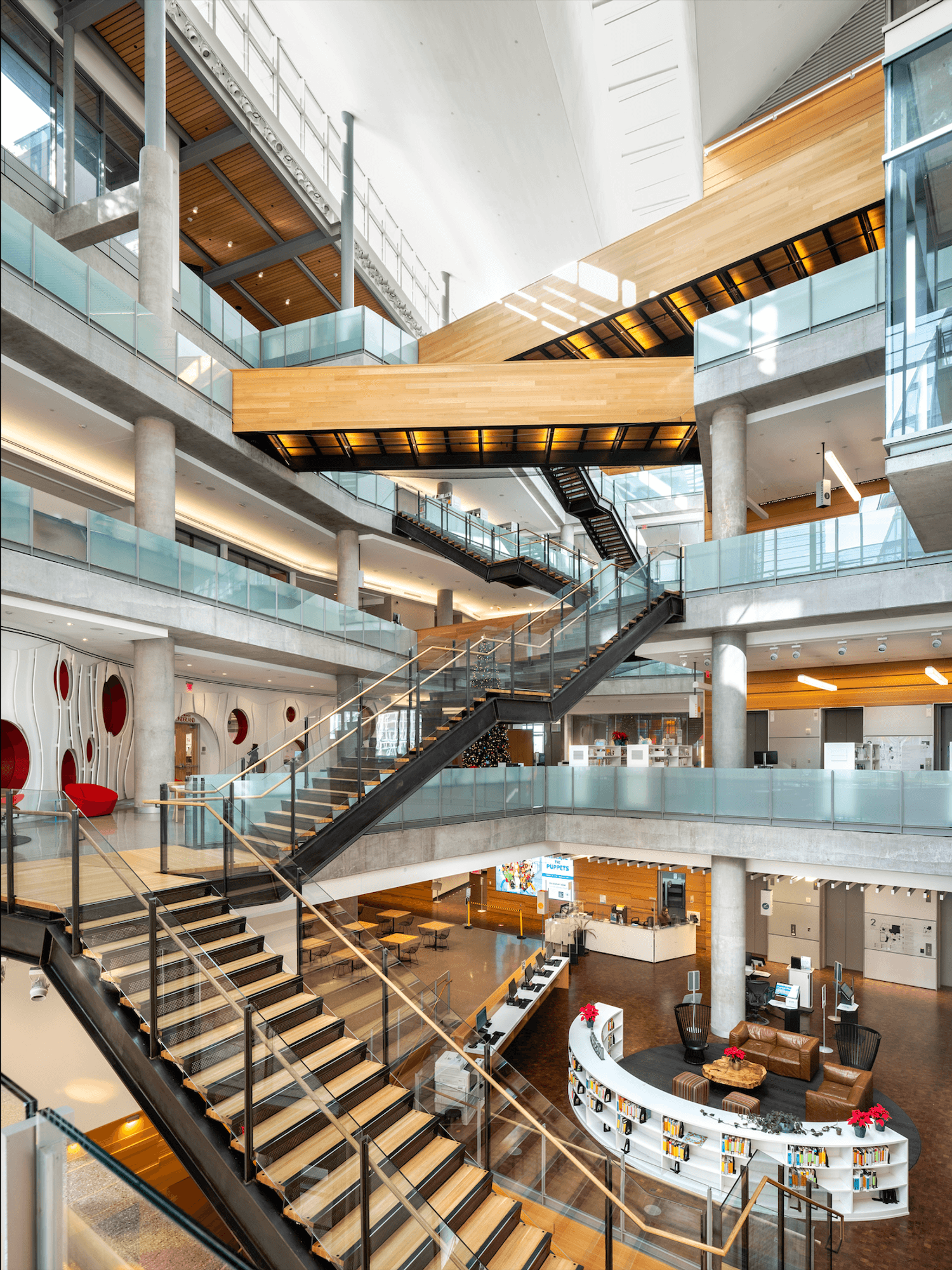 The Austin Central Library is worth visiting from an architectural perspective alone.Photos by Leonid Furmansky
Klinenberg didn't have the space to list the library amenities that support to these claims, but we do:
- Civic hub: The Central Library helps Austinites get passports, organizes civic resources, and sets librarians up with people who need information on things like researching projects and filling out student aid applications. Two bus stops right outside the library and a parking garage below make it one of the easiest places to access downtown.
- Antidote to social isolation: The whole building is full of cozy places to sit and face others. The library also schedules regular social events and maintains clubs like the Teen Zine Club. (It even has a zine collection that's always on display.) A community bulletin board helps Austinites connect outside of the library.
- Play space: Plenty of events at the library cater to kids, and the Innovation Lab is a fun and productive place to visit for folks who want to make digital music, edit photos, record podcasts, make 3D prints, and more. There is art all over the library, especially in the second floor gallery, and staff bring visitors on multi-floor art tours.
- Ecological refuge: On the roof of the Central Library, visitors sit around a butterfly and pollinator garden full of native Texas plants and overlook Lady Bird Lake. According to the library, the largest rooftop solar installation in downtown Austin provides shade for the garden. A cabinet in the library also provides a hub for Austinites to share seeds by taking them home, growing plants, and harvesting more seeds to bring back and replenish the stash.
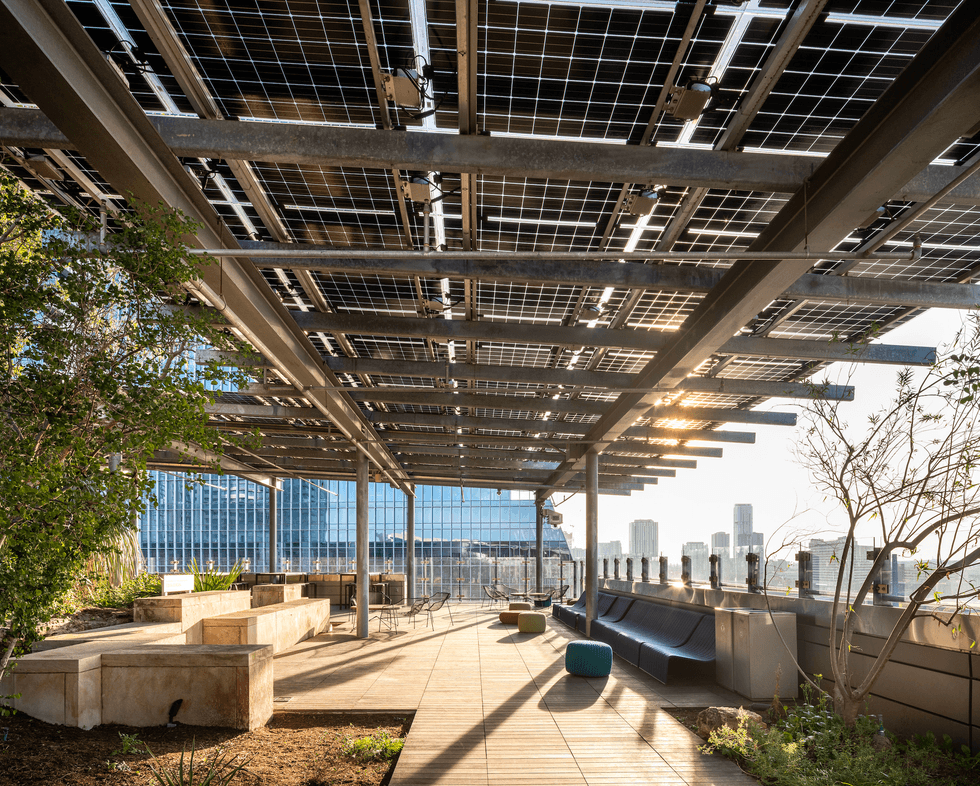 There's so much to look at on this rooftop that it's easy to miss the solar panels above.Photos by Leonid Furmansky
As hopeful as the library nomination is, the Time list isn't all positive. In fact, Austin's library triumph is obliquely offset by a photo from Austin illustrating "The single-family subdivision," almost the antithesis to the library.
"Single-family zoning covers more of this country’s livable urban land than any other designation," writes Jeff Speck, city planner and author of Walkable City: How Downtown Can Save America, One Step at a Time. "Only in America are we so keen to dedicate so much territory to the most unaffordable, carbon-intensive, and socially isolating type of housing. It’s telling that most of us say we’d rather live in walkable, mixed-use communities, but few are given that choice. It’s time to build real neighborhoods again."
Other Texas places made the list, too: The Houston Astrodome and the proposal for the redesign of Dealey Plaza and Martyrs Park in Dallas. Because of NASA's Lyndon B. Johnson Space Center in Houston, Space City is also connected to at least two other things on the list, the International Space Station and Artemis II.
Since "The American Library" as a concept is also one of the items on the list, all Texans can go to whichever is library is closest to them and pat their communities on the proverbial back for making it. No one does it like Austin, though.