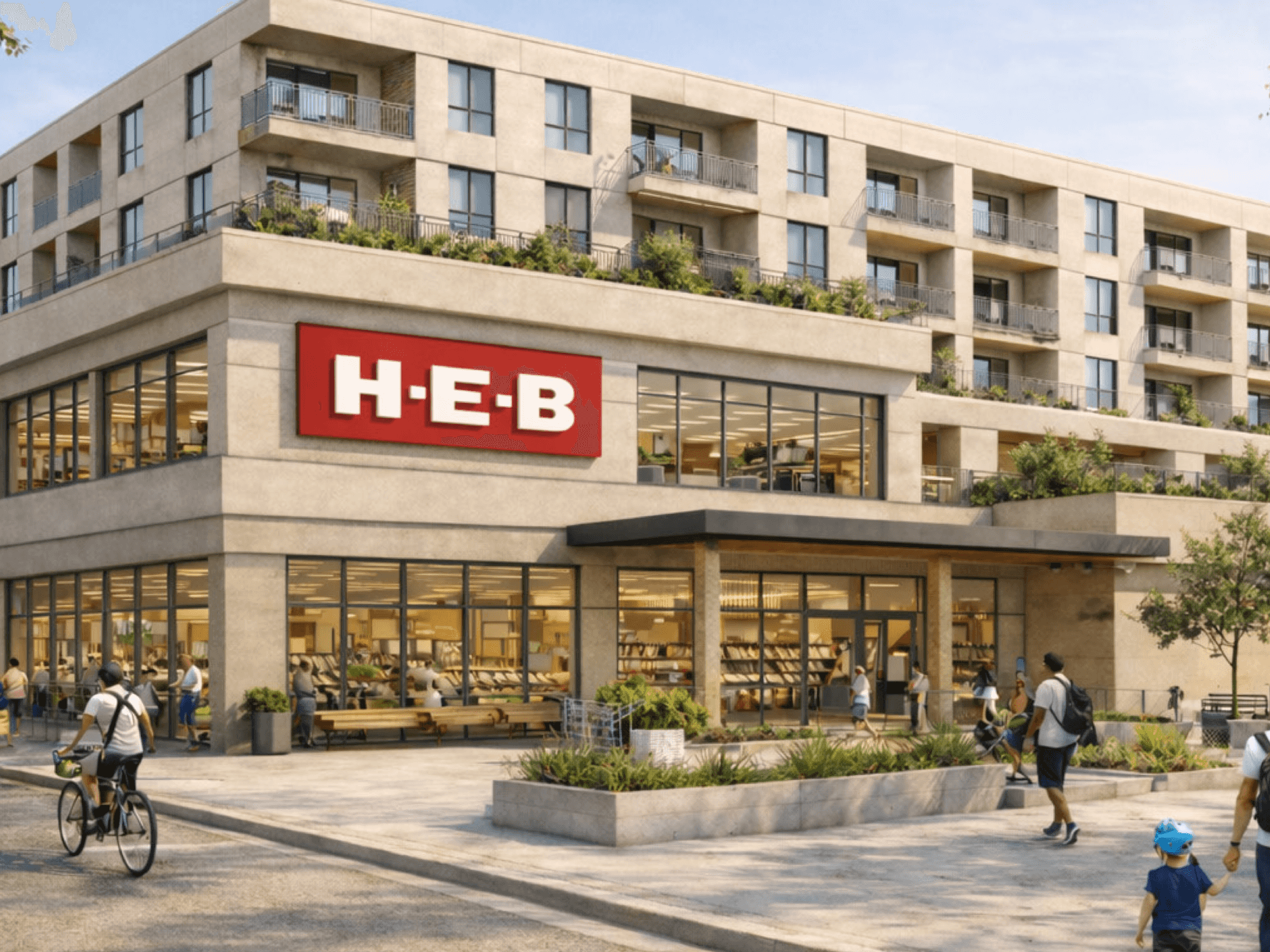
The reimagined Hancock Center would include a new 160,000-square-foot H-E-B grocery store.
If a team of students from the University of Texas got their way, the site of the 63-year-old Hancock Center in Central Austin would be transformed into a nearly $1.3 billion mixed-use development.
The five-member team won this year’s ULI/Gerald D. Hines Student Urban Design Competition with their 10-year vision for The GreenLink, which would replace the Hancock Center retail hub. The more than 1.6 million-square-foot project would feature at least two current tenants, H-E-B and Central Health, as well as:
- More than 265,000 square feet of retail space, including the H-E-B store
- More than 1,600 apartments
- 42 townhomes
- 70,000 square feet of office space
- A convention center and 275-room hotel
- A co-living space
- A community club
- A wellness center
- A library
- An arts and culture destination
Various environmentally friendly elements would help put the green in The GreenLink. They’d include charging stations for electric vehicles, rainwater collection systems, a grid of solar panels, a self-contained food production ecosystem, and a geothermal-powered HVAC system.
In the annual ULI/Hines competition, teams of five students pursuing degrees in at least two disciplines get two weeks to produce development plans for an actual large-scale site in a North American city. Every team’s proposal includes renderings, narratives, market research, and financial figures.
Each of the 79 college teams in this year’s competition was tasked with reimagining Hancock Center.
Envisioning a “viable and livable” place
Michael Alada, a graduate student in urban planning and sustainable design at UT who led the winning team, says he and his fellow teammates “set out to design a development that is both viable and livable, and somewhere we would genuinely want to be, while promoting health and sustainability.”
The Placemakers team won a first-place prize of $35,000 for their GreenLink concept.
Alada said the team drew inspiration from Austin’s South Congress Avenue and Second Street districts “on how to create a vertical mixed-use retail edge, but with our own twist.”
Other members of the winning UT team are students Anushka Deshpande, Sushmita Gautam, Josh Hu, and Meng-Shin Lin.
Primed for redevelopment?
Regency Centers owns the nearly 246,000-square-foot Hancock Center. A representative of Regency couldn’t be reached for comment about the UT team’s reimagination of Hancock, located on East 41st Street between Red River Street and I-35.
On its website, Regency lists Hancock as a candidate for redevelopment. But as UT points out, “there is no expectation that anyone will apply the submitted [plan] to the site.”
Justin Chapman, who chaired the judging panel for the 2026 Hines competition, says judges picked The GreenLink idea as the winner “due to the strength of its organizing design principle as a physical and intellectual connection to the city [and] the thoughtfulness of its proposed execution and programming, along with a cohesive display of teamwork.”
Chapman is an executive at The Integral Group, an Atlanta-based real estate developer.
A six-decade fixture in Austin
Hancock Center debuted in 1963 as Austin’s first mall-style shopping center. In addition to H-E-B, tenants include Jo’s Coffee, Jersey Mike’s Subs, GNC, The UPS Store, and Freebirds World Burrito. Central Health, which provides healthcare services for low-income residents of Travis County, occupies the center’s former Sears department store, an original tenant that closed in 2019.
San Antonio general contractor Bartlett Cocke designed Hancock Center, whose first tenant was a freestanding Sears automotive center that opened in 1963, according to the Mall Hall of Fame blog. That same year, the president of Sears, the mayor of Austin and Miss Texas 1963 cut the ribbon for the grand opening of a two-level, 147,800-square-foot Sears store.
Other early tenants included a 52,000-square-foot H-E-B, an 88,000-square-foot Dillard’s store, Wyatt’s Cafeteria, and Sommers Rexall Drug. Since then, H-E-B has expanded its Hancock store, while Dillard’s, Wyatt’s Cafeteria, and Sommers Rexall Drug are long gone.